

What is PRP Hair Loss Therapy?
Platelet Rich Plasma (PRP) Hair Loss Therapy leverages the healing power of your body’s natural healing resources. A small sample of your blood is drawn and processed to isolate platelet-rich plasma. This concentrated solution is rich in growth factors that play a vital role in hair growth and regeneration.
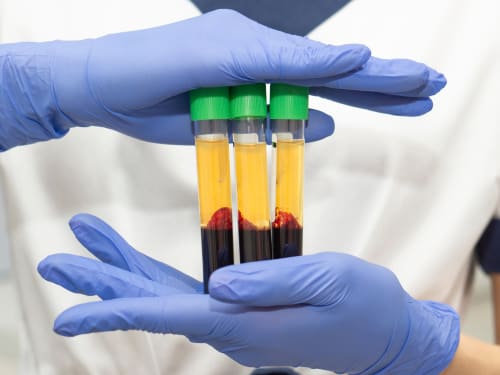
How Does PRP Work for Hair Loss?
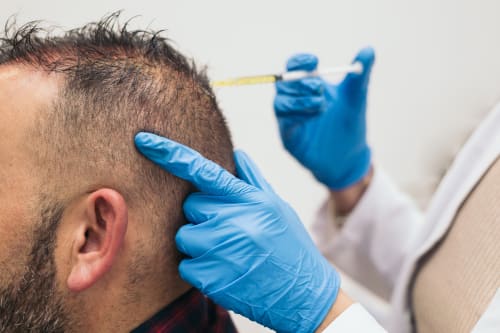
During the treatment, PRP is injected directly into the scalp, targeting areas experiencing thinning or hair loss.
Concentrated growth factors - including platelet-derived growth factor (PDGF), vascular endothelial growth factor (VEGF), and insulin-like growth factor (IGF-1) - stimulate dermal papilla cells at the base of your hair follicles. These specialised cells orchestrate the hair growth cycle. The growth factors signal dormant follicles to re-enter their active growth phase whilst improving blood supply to your scalp.
This dual action creates an optimal environment for hair regeneration, promoting:
- Increased blood flow to the scalp
- Enhanced nutrient delivery to hair follicles
- Stronger and thicker hair growth
Benefits of PRP Hair Loss Therapy
Promotes Hair Growth
Experience a noticeable increase in hair density and thickness.
Slows Down Hair Loss
PRP can help prevent further hair loss and maintain existing hair health.
Suitable for Most Hair Types
PRP is a safe and effective treatment for various hair loss concerns.
Assists Hair Transplants
PRP therapy can enhance the results and longevity of hair transplants.
Minimally Invasive
PRP is a non-surgical procedure with minimal discomfort and downtime.
PRP and iPRF: Choosing Your Regenerative Approach
At Creative Touch, we offer traditional PRP and advanced iPRF hair therapy to clients in Rotherham, Sheffield, and across South Yorkshire. PRP and iPRF each have distinct advantages for different needs and circumstances.
Which is right for you? During your consultation, we’ll assess your hair loss pattern, review your goals and budget, and recommend the approach that best suits your situation. Many clients achieve excellent results with PRP’s proven efficacy, whilst others prefer iPRF’s enhanced regenerative technology. Both treatments follow similar protocols: 3-4 initial sessions spaced 4-6 weeks apart, followed by maintenance every 6-12 months.
PRP Hair Therapy uses your body’s concentrated growth factors to stimulate dormant follicles and improve scalp health. It’s our established treatment with proven clinical results, particularly effective for early-stage hair loss and ongoing maintenance. Growth factors are released within hours of treatment, providing an effective regenerative signal to your hair follicles. At £150 per session, it offers excellent value for those seeking natural hair restoration.
Injectable Platelet-Rich Fibrin (iPRF) represents next-generation regenerative therapy. Its specialised processing captures not only platelets but also stem cells and white blood cells, creating a fibrin matrix that releases growth factors continuously for over a week. This sustained signalling can produce more robust follicle regeneration, with approximately 10 times the platelet concentration and more circulating stem cells than standard PRP. iPRF sessions are priced at £200 per treatment. Discover our iPRF treatments.
How Many Treatments Are Needed?
We recommend a minimum of 3 treatments, once a month for 3 months. Afterwards, maintenance appointments at 3-6 month intervals ensure optimum results.
How Much Does It Cost?
A PRP appointment takes approximately one hour and costs £150.
What Are The Side Effects?
Side effects are limited and whilst most clients experience none, you may experience:
- slight discomfort during treatment
- headache
- itching
- swelling
- temporary discolouration
A Personal Approach
At Creative Touch, we understand that hair loss is unique to each individual. During your consultation, we’ll assess your scalp health and hair loss pattern to determine if PRP therapy is the best option for you.
The Creative Touch Difference
Experienced Professionals: We are highly skilled and dedicated to helping you achieve your hair growth goals.
Advanced Technology: We use the latest PRP technology to ensure the highest concentration of growth factors for optimal results.
Comfortable & Efficient: Our experienced team ensures your PRP treatment is comfortable and efficient.
Safe & Effective: PRP is a safe and well-tolerated treatment with minimal side effects.
Ready to Regain Your Confidence with Thicker, Fuller Hair?
Schedule a consultation at Creative Touch today to discuss how PRP Hair Loss Therapy can help you. We’ll guide you through the entire process and create a treatment plan to revitalise your hair growth and restore confidence.
If you’re interested in understanding the cellular mechanisms behind regenerative hair treatments, our science deep-dive into PRP and iPRF provides fascinating insights into how growth factors trigger follicle regeneration.
Frequently Asked Questions About PRP Hair Therapy
- When will I see results?
Hair restoration requires patience because we’re working with your natural hair growth cycle. PRP stimulates dormant follicles to re-enter their active growth phase, but this biological process takes time. Most clients notice subtle changes around 2-3 months after beginning treatment, with more visible improvements at 4-6 months as new hair completes its growth cycle. Maximum results typically appear at 6-9 months.
We’re supporting your body’s natural regenerative process, not applying an instant cosmetic solution. The gradual improvement reflects genuine biological change in your scalp and follicles.
- Does PRP work for all types of hair loss?
PRP is most effective for androgenetic alopecia (pattern hair loss) and early to moderate-stage thinning. It works by awakening dormant follicles and strengthening existing hair, so it’s most successful when hair follicles are still present but underperforming.
PRP cannot regenerate follicles that have been completely absent for many years, and it’s less effective for hair loss caused by autoimmune conditions, severe nutritional deficiencies, or certain medical treatments. During your consultation, we’ll honestly assess your hair loss pattern and discuss realistic expectations for your specific situation.
- Is PRP hair treatment painful?
Most clients find PRP hair therapy surprisingly comfortable. We apply topical anaesthetic to your scalp approximately 20-30 minutes before treatment, which significantly reduces sensation. During the injections, you may feel slight pressure, tingling, or minor pinprick sensations, but the procedure is generally well-tolerated.
The fine needles we use minimise discomfort, and the treatment is completed within 15-20 minutes once preparation is complete. Any sensitivity typically subsides within a few hours.
- Can I combine PRP with other hair loss treatments?
Yes. PRP complements many hair loss treatments beautifully. It works alongside topical treatments like minoxidil, supplements, light therapy, and oral medications. PRP can also enhance hair transplant results when performed before or after the procedure, supporting better graft survival and improved density in both transplanted and existing hair.
During your consultation, we’ll review your current treatment plan and advise on optimal timing and integration. Some medications (particularly blood thinners) may need to be discussed with your prescribing doctor before PRP treatment.
- How long do PRP results last?
With proper maintenance, PRP hair therapy results can last 12-18 months or longer. However, because hair loss is often a progressive condition, maintenance is typically required to sustain improvements.
After completing your initial course of 3 treatments, we recommend maintenance sessions every 6-12 months. These ongoing treatments help preserve the improvements you’ve achieved and continue supporting healthy hair follicle function. Many clients find that maintenance becomes less frequent over time as their hair stabilises.
- Am I suitable for PRP hair therapy?
Most adults experiencing hair thinning are suitable candidates for PRP. The treatment uses your own blood, so there’s minimal risk of allergic reactions or rejection. However, PRP may not be recommended if you have:
- Active scalp infections or skin conditions
- Certain blood disorders or platelet dysfunction
- Are taking blood-thinning medications (we’ll need to discuss with your doctor)
- Have severe anaemia
- Are undergoing chemotherapy or certain medical treatments
During your consultation, we’ll review your complete medical history, examine your scalp and hair loss pattern, and determine whether PRP is safe and likely to be effective for your specific situation.
- What’s the difference between PRP for hair and PRP facials?
Whilst the preparation process is similar, the treatment approach differs. PRP for hair involves injecting the concentrated plasma into your scalp at the level of hair follicles, specifically targeting areas of thinning. PRP facials involve multiple microinjections across facial skin or microneedling with PRP applied topically to stimulate collagen production and improve overall skin quality.
The growth factors work differently in each location: stimulating hair follicle regeneration in the scalp, and promoting collagen synthesis and skin renewal in facial tissue. We offer both treatments. Discover our PRP “Vampire” Facial for skin rejuvenation.
- What is Growth Factor Concentrate (GFC), and how does it compare to PRP?
GFC is a newer autologous treatment. Like PRP, it’s derived from your own blood, but it takes a different approach to preparation. Rather than injecting concentrated platelets, GFC uses a specialist activation kit to release the growth factors from your platelets before processing. The final injectate contains only the concentrated growth factor molecules themselves, with all blood cells removed.
Think of it as a more refined version of the same principle: PRP delivers growth factors packaged inside platelets, which release them over several hours once injected. GFC delivers them in a pre-released, cell-free form. Early research is promising, but GFC’s evidence base is still developing compared to PRP’s decades of clinical data.
We don’t currently offer GFC at Creative Touch, but if you’ve been reading about it, our iPRF treatment is worth considering. iPRF sits at the more advanced end of the same spectrum: it delivers a higher growth factor concentration than standard PRP, sustained over a week or more through a fibrin matrix. Your consultation is the best place to talk through which approach suits your situation.