
Sodium lauryl sulfate
Sodium lauryl sulfate (SLS) is the reference irritant used in controlled barrier disruption research precisely because its mechanism is well-characterised and reproducible. It disrupts the stratum corneum in two stages: intercalating into and disordering the long lamellar lipid phase during wash contact, then continuing to extract barrier lipids from protein-bound residues after rinsing has ended. Hard water amplifies both stages – calcium and magnesium ions reduce SLS solubility, increasing skin deposition 2.8-fold compared with deionised water in a controlled study of 80 participants. Those residues increase TEWL by 7.12 g/m²/h in healthy skin and 13.84 g/m²/h in atopic patients carrying FLG mutations. Downstream, SLS exposure alters PPARα-linked lipid metabolism gene expression and transiently suppresses KLK5 and KLK7 – the desquamation enzymes – at the mRNA level. Ion-exchange water softening reduces deposition to near-deionised levels; chlorine has no significant effect.
SLS is not an unusual or exotic compound – it is one of the most widely used surfactants in personal care products globally, present in most mainstream cleansers, shampoos, body washes, and toothpastes. Its relevance to barrier biology is not primarily a question of whether it is “safe” in formulated products. It is the reference standard against which all surfactant barrier disruption research is measured because its mechanism is precise, its effects are dose-dependent and reproducible, and it is the compound used to deliberately create controlled barrier impairment in clinical studies. Understanding what SLS does to the stratum corneum, and under what conditions it does more of it, is the foundation for understanding surfactant selection in barrier-compromised skin. [4]
How SLS disrupts the barrier
Stage 1 – lamellar bilayer disorganisation during wash contact. SLS molecules intercalate into the long lamellar phase of stratum corneum intercellular lipids – the specific lipid phase responsible for the skin’s primary water-holding and permeability barrier function. Synchrotron X-ray diffraction studies confirm progressive structural disorganisation of the long lamellar phase through two or more transition states under SLS exposure, whilst the short lamellar and hydrocarbon chain packing structures are comparatively less affected. The timeline is contact-duration dependent: bilayer delamination and roll-up begin within one hour, extensive disruption is present at six hours, and near-complete corneocyte dissociation occurs at 24 hours under continuous exposure. [3]
Stage 2 – residue deposition and continued extraction post-rinse. SLS binds to corneocyte proteins and remains on the skin surface after washing. These residues continue extracting barrier lipids and altering protein secondary structure after rinsing has ended. The standard assumption – that rinsing terminates SLS exposure – is incorrect. Residue-driven lipid extraction is the mechanism that makes wash duration, rinse thoroughness, and post-wash dressing choices clinically relevant variables rather than secondary concerns. [1]
Stage 3 – downstream gene expression effects. 24-hour exposure to 1% SLS in healthy skin in vivo produces decreased profilaggrin mRNA within six hours, KLK5 and KLK7 mRNA reduced by 75% and 50% respectively at six hours (transiently impairing both desquamation enzyme availability and cathelicidin processing), and disrupted PPARα-linked lipid metabolism gene expression in the repair phase. The barrier disruption is not a surface event – it reaches into the lipid synthesis, differentiation, and desquamation programmes. [2]
The hard water amplification
Danby et al. (JID, 2018, n=80) is the definitive study on hard water–SLS interaction. Its controlled design – six water types varying hardness and chlorine independently, across four participant groups stratified by AD status and FLG mutation – allows the hard water mechanism to be isolated precisely. [1]
Calcium and magnesium ions in hard water reduce the aqueous solubility of anionic surfactants, causing precipitation and increased partitioning onto the skin surface during rinsing. The result: SLS deposition in hard water was 2.8-fold greater than in deionised water. Those deposits correlated directly with both TEWL increase and objective skin redness. The deposition also produced measurable lipid chain disordering and protein denaturation in the SC, confirmed by FTIR spectroscopy, with both changes correlating significantly with residue levels.
TEWL increase from SLS residues in hard water versus deionised water:
| Participant group | TEWL increase – hard water | TEWL increase – deionised |
|---|---|---|
| Healthy skin (FLG wild-type) | 7.12 ± 0.84 g/m²/h | 3.78 g/m²/h (approx.) |
| AD patients (FLG mutation) | 13.84 ± 1.68 g/m²/h | Significantly lower |
The FLG mutation amplification is clinically significant: it is not that FLG mutation carriers deposit more SLS (deposition was equal across all groups) – it is that their compromised barrier produces a substantially greater downstream response to the same residue load. Carrying an FLG loss-of-function mutation additively increases hard water sensitivity on top of the AD barrier defect.
Chlorine showed no consistent significant effect on SLS deposition or barrier response, despite being included as a controlled variable. The driver is calcium and magnesium ion concentration specifically. Ion-exchange water softening, reducing hardness below 25 mg/L CaCO₃, dramatically reduced SLS residues and mitigated the TEWL and redness responses to near-deionised levels.
One practical implication the study notes explicitly: because hard water produces less foam with SLS cleansers, clients in hard water areas tend to apply more product to achieve the same perceived cleansing result. The study’s controlled SLS dosing therefore likely underestimates real-world hard water exposure from everyday washing.
Surfactant alternatives in context
SLS’s barrier disruption properties are partly a function of its molecular structure: it is a straight-chain anionic surfactant whose negative charge facilitates tight protein binding and whose molecular dimensions allow deep intercalation into the SC lipid lamellar structure.
| Surfactant type | Example | SC penetration | Relative irritation | pH effect |
|---|---|---|---|---|
| Anionic (straight-chain) | SLS | Deep intercalation into long lamellar phase | High | Raises SC pH regardless of product formulated pH |
| Anionic (ethoxylated) | SLES (sodium laureth sulfate) | Reduced – larger molecule limits intercalation | Markedly lower | Lower than SLS |
| Amphoteric | Cocamidopropyl betaine | Minimal – charge-neutral at skin pH | Low | Minimal acid mantle disruption |
| Non-ionic | Coco-glucoside, decyl glucoside | Minimal lipid interaction | Very low | Minimal |
One point worth addressing directly for clients with high product label literacy: a “pH-balanced” product containing SLS is not the reassurance it might appear. SLS raises SC pH through its surfactant mechanism independently of the product vehicle’s formulated pH. The product may be pH 5.5 – the SC surface pH after washing may not be.
Clinical Application
For clients with barrier-compromised, reactive, or atopic skin, cleanser surfactant type is the highest-leverage product category. SLS in hard water areas is not a theoretical concern – the 2.8-fold residue amplification from a single wash cycle is measurable within hours via TEWL and FTIR. The sequencing implications are direct:
- Post-procedure: any treatment that disrupts the SC (laser, microneedling, chemical peels, ablative procedures) creates a window in which SLS residues in hard water will deposit at amplified levels onto a barrier that is simultaneously attempting the calcium-triggered repair sequence. The two mechanisms compound against each other
- Atopic and FLG-carrier clients: the amplification is specifically greatest in this group – not because they are more sensitive subjectively, but because the downstream barrier response to residues is measurably greater per unit of deposited SLS
- Practical cleanser guidance: the shift from SLS to SLES or amphoteric alternatives is a mechanistically justified reduction in residue deposition and lamellar disruption with documented barrier consequence – not a marketing positioning decision
Clinical Pearl Clients who wash their face more thoroughly when their skin is reacting – longer wash time, more product to achieve lather in hard water – are doing the opposite of what their barrier needs. More SLS in harder water for longer contact time produces greater residue deposition, greater lamellar disorganisation, and greater post-rinse lipid extraction. The correct response to a reactive barrier is a brief, cool rinse with a non-SLS cleanser or water alone, followed by immediate barrier support product application while the skin is still slightly damp. The instinct to wash more thoroughly when skin is irritated is understandable – but it actively worsens the mechanism driving the reaction.
References
Danby SG, Brown K, Wigley AM, et al. (2018). The Effect of Water Hardness on Surfactant Deposition after Washing and Subsequent Skin Irritation in Atopic Dermatitis Patients and Healthy Control Subjects. J Invest Dermatol, 138(1), 68-77 . doi.org/10.1016/j.jid.2017.08.037
Törmä H, Lindberg M, Berne B (2008). Skin barrier disruption by sodium lauryl sulfate-exposure alters the expressions of involucrin, transglutaminase 1, profilaggrin, and kallikreins during the repair phase in human skin in vivo. J Invest Dermatol, 128(5), 1212-9 . doi.org/10.1038/sj.jid.5701170
Warner RR, Boissy YL, Lilly NA, et al. (1999). Water disrupts stratum corneum lipid lamellae: damage is similar to surfactants. J Invest Dermatol, 113(6), 960-6 . doi.org/10.1046/j.1523-1747.1999.00774.x
Yanase K, Hatta I (2018). Disruption of human stratum corneum lipid structure by sodium dodecyl sulphate. Int J Cosmet Sci, 40(1), 44-49 . doi.org/10.1111/ics.12430
Molecular Structure
- Formula
- C₁₂H₂₅NaO₄S
- Weight
- 288.38 g/mol
- IUPAC
- sodium dodecyl sulfate
Computational Identifiers
| InChI | InChI=1S/C12H26O4S.Na/c1-2-3-4-5-6-7-8-9-10-11-12-16-17(13,14)15;/h2-12H2,1H3,(H,13,14,15);/q;+1/p-1 | |
|---|---|---|
| InChIKey | DBMJMQXJHONAFJ-UHFFFAOYSA-M | |
| Canonical SMILES | CCCCCCCCCCCCOS(=O)(=O)[O-].[Na+] | |
Data sourced from: PubChem (NCBI) ↗ | ||
Also Known As
- SDS
- SLS
- sodium dodecyl sulfate
Learn More
This topic is discussed in 2 articles:
-
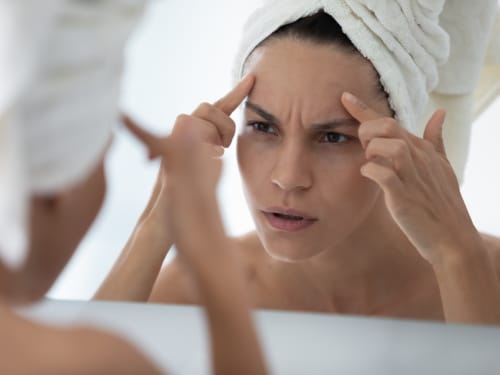
A common anionic surfactant used in cleansers and shampoos. Becomes less soluble in hard water and deposits on skin rather than rinsing away cleanly. Residues actively dissolve barrier lipids, denature keratin proteins, and raise skin pH in a dose-dependent manner. Hard water substantially amplifies SLS-related skin irritation compared to the same cleanser used in soft water.
-
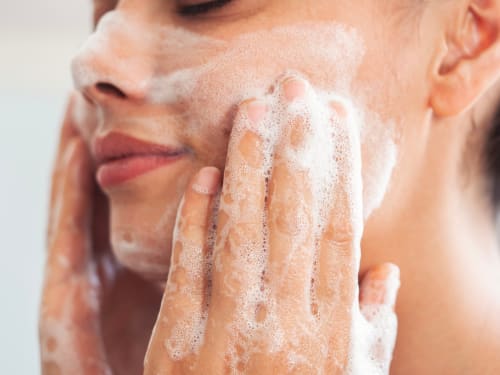
An anionic surfactant used in cleansers, shampoos, and personal care products that disrupts the stratum corneum through two sequential mechanisms.
-
An anionic surfactant used in cleansers, shampoos, and personal care products that disrupts the stratum corneum through two sequential mechanisms.