
What’s in this audio? (Click to expand)
- Introduction: The Sterility Myth: The bathroom sink scenario that launches a complete rethink of what “clean” skin actually means.
- Your Microbial Workforce: How S. epidermidis manufactures ceramides as a by-product of feeding, and why wiping it out shuts down your skin’s on-site moisture factory.
- C. acnes Reconsidered: The rehabilitation of the most misunderstood bacterium in dermatology — how it builds barrier proteins and provides a 24-hour antioxidant shield via RoxP.
- The Acne Paradox: Why acne is a problem of phylotype imbalance, not bacterial overgrowth — and why broad-spectrum antibiotics make the ecology worse over time.
- The Acid Mantle & KLK5: The pH 5.0 master switch that keeps the KLK5 enzyme from dissolving your own barrier, and what Netherton syndrome proves when this system fails entirely.
- Hard Water & Alkaline Cleansers: How Yorkshire tap water and a foaming sulphate cleanser can pull the safety pin on the KLK5 enzyme every single morning.
- The Dysbiosis Loop: The self-reinforcing spiral where S. aureus moves in, destroys filaggrin, collapses the acid mantle, and makes the environment even more hostile to the commensals defending it.
- When Nerves Learn to Panic: How chronic inflammation physically rewires sensory nerves, creating a neural memory of itch and flushing that outlasts the original flare-up by months.
- Perimenopause & the Microbiome: The HELIOS study finding that oestrogen withdrawal causes a 60% collapse in the C. acnes workforce — and why this is an ecological event, not a skin failure.
- Rebuilding the Ecosystem: The mechanistic science behind selective inulin prebiotics, V. filiformis postbiotics, and cold atmospheric plasma — and which has Tier 1 clinical evidence.
- Summary & the Gut-Skin Axis: The full journey recapped, plus the provocative closing question: is your daily dietary fibre intake dictating your skin’s resilience from the inside out?
You’re at the sink, steam rising from the warm water, working a cleanser into your face. Maybe it’s the foamy one labelled “deep clean” or “purifying,” maybe it’s the antibacterial hand wash you grabbed in a hurry – that familiar fresh-chemical scent, the slight tingle that says it’s doing something. Either way, somewhere on that bottle is a version of the same promise: kills 99.9% of bacteria. You bought into it. Most of us have. The problem is that your skin doesn’t agree.
Your skin bacteria aren’t passengers. They’re workers. Staphylococcus epidermidis, the most abundant commensal on healthy skin, produces an enzyme that converts skin lipid precursors into ceramides, the moisture-locking molecules that comprise roughly half of your barrier’s lipid structure. Cutibacterium acnes, long framed as the acne villain, triggers keratinocyte receptors that stimulate barrier lipid production and help maintain the acidic surface pH that keeps genuinely harmful bacteria out. Remove these organisms, and you remove key steps in your skin’s own barrier manufacturing process. The “kills 99.9%” claim is accurate. The issue is that it treats this as an achievement.
If you’ve diligently followed a skincare routine and still found your barrier underperforms, or noticed that antibacterial or “clarifying” products seem to make reactivity worse rather than better, that pattern has a mechanism. This article covers what your skin’s microbial community actually does, what disrupts it, and what genuinely helps restore balance, including some clinical approaches that work on the microbial environment directly. It won’t tell you to throw out everything in your bathroom. But it will change how you read the label.
For a grounding in the barrier itself – ceramide structure, filaggrin, and transepidermal water loss – our complete guide to barrier repair covers that territory. This article builds on those foundations.
Meet Your Skin’s Working Population
What actually lives on your skin
Your skin spans roughly 1.8 square metres and hosts hundreds of microbial species, though the populations vary dramatically by body site. Sebaceous areas like the face and upper chest favour oil-tolerant organisms. Cutibacterium and Malassezia species dominate here, as both depend on lipid-rich environments. Moist sites like armpits and feet support different communities: Corynebacterium and Staphylococcus species thrive in these conditions. Dry sites like forearms and legs host more diverse communities from all three major groups.
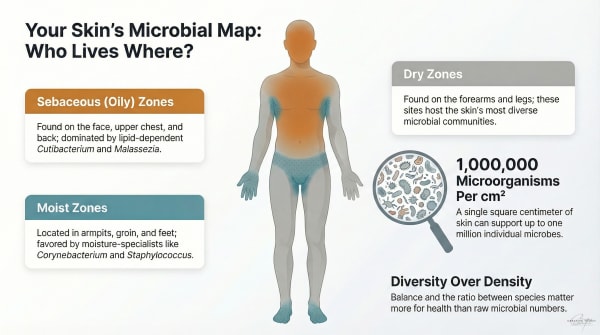
The numbers involved are genuinely striking. A single square centimetre of skin can support up to one million microorganisms. But the relationship isn’t simply “more microbes equals more problems.” Diversity and the ratio between species, community balance, matter far more than raw numbers.
What healthy commensals actually do for your barrier
This is the part that reframes everything. The skin microbiome isn’t just sitting there being tolerated by your immune system. It’s actively contributing to your barrier’s structure and maintenance.
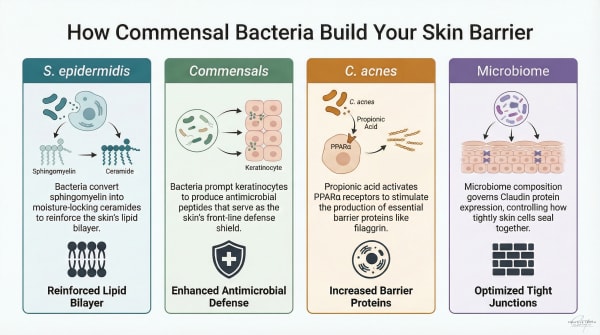
The ceramide connection. Research in mouse models demonstrates that S. epidermidis secretes a sphingomyelinase enzyme that converts sphingomyelin, a host lipid, into ceramides, a process that provided a measurable additional source of these barrier-protective molecules and reduced water loss in damaged skin. [1] The mechanism is a genuine mutualism: the bacterium gains sphingomyelin breakdown products as a food source, and the host benefits from additional ceramide synthesis. Whether this mechanism operates at similarly significant levels in human skin awaits clinical confirmation. The primary evidence is from mouse models. But the biological rationale is sound, and the implications are worth understanding. Your own skin cells produce ceramide independently, but S. epidermidis contributes an additive source. This is not a redundant process.
It’s also worth noting that the relationship between ceramides and the microbiome works both ways. A 2026 double-blind study found that topical ceramide application not only replenished barrier lipids but also improved microbiome diversity scores, suggesting the barrier and its microbial community are in a genuinely bidirectional regulatory relationship, not simply a one-way dependency. [2]
The immune training role. S. epidermidis colonisation prompts keratinocytes to produce antimicrobial peptides, specifically LL-37 and defensin-β4, that function as front-line defenders against pathogenic invasion. [3] The mechanism is more sophisticated than simple defence, though. S. epidermidis activates Toll-like receptor 2 (TLR2) signalling pathways that produce β-defensin-3 and simultaneously induce regulatory proteins that prevent NF-κB overstimulation. [4] In practical terms, your commensal bacteria are teaching your immune system how to mount targeted defences without triggering the runaway inflammation that makes skin so reactive.
The lipid synthesis trigger. Cutibacterium acnes, yes, the bacterium associated with acne, plays a more complex role than its reputation suggests. Commensal C. acnes produces propionic acid from sebum fatty acids. This propionic acid has been shown in keratinocyte models to activate peroxisome proliferator-activated receptor alpha ( PPARα) receptors, stimulating production of barrier-protective lipids and proteins including filaggrin and loricrin. [5] The same propionic acid pathway lowers surface pH, maintaining the acidic environment that prevents Staphylococcus aureus from establishing a foothold.
C. acnes is not inherently an enemy. In balanced, open-pore sebaceous skin, it provides barrier lipid synthesis signals. It’s when follicles become obstructed, changing the local oxygen and pH environment, that the same organism contributes to inflammation. This distinction matters clinically because broad-spectrum anti-C. acnes treatments may remove a key signal in the barrier production chain, not just a skin problem.
Tight junctions. The microbiome’s influence extends to the structural connections between skin cells. Emerging research shows that microbiome composition can regulate Claudin (CLDN) protein expression, the proteins that control tight junction architecture between keratinocytes, directly governing intercellular permeability. [6] A change in your microbial community is a change in how tightly your cells seal together.
When Balance Tips: Dysbiosis and the Barrier
The vicious cycle
Dysbiosis (microbial imbalance) and barrier dysfunction don’t just co-exist. They amplify each other in a self-reinforcing loop.
In healthy skin, Staphylococcus aureus is present in very small numbers. The acidic surface pH, maintained by commensal metabolic activity, creates conditions it doesn’t tolerate well. Antimicrobial peptides produced by S. epidermidis and other commensals keep it in check. But when the barrier is disrupted by hard water, harsh cleansers, genetic filaggrin variants, or other stressors, surface pH rises. Transepidermal water loss (TEWL) increases. The habitat becomes less hospitable for acid-tolerant commensals and more permissive for S. aureus.
Once S. aureus establishes itself, the situation actively worsens. It produces virulence factors, including α-toxin and δ-toxin, that degrade the antimicrobial peptides produced by beneficial bacteria, directly eliminating the immune defences that would otherwise control it. [[7], [8]] It produces proteases that degrade filaggrin, removing the natural moisturising factor production pathway and further elevating pH. The result is a cascade: barrier disruption drives dysbiosis, dysbiosis drives further barrier disruption.
This loop is particularly well-characterised in atopic dermatitis. Lesional AD skin shows dramatically reduced microbial diversity, loss of S. epidermidis and Corynebacterium species, and S. aureus domination. Research into filaggrin gene variants confirms that filaggrin deficiency creates a lesional microbiome environment specifically enriched for S. aureus colonisation pathways. [9] The genetics of barrier dysfunction and the microbiology of skin disease are more intertwined than either field has historically acknowledged.
What’s disrupting your microbiome
Several everyday factors can shift this balance, some of which are less obviously damaging than others.
Over-cleansing and harsh surfactants are among the most common disruptions. SLS-based cleansers and high-frequency washing reduce microbial diversity indiscriminately. They don’t selectively remove pathogens. The microbiome recovers, but repeated disruption can shift community composition over time.
Antibacterial soaps have a similar problem at larger scale. Products containing triclosan or other broad-spectrum antimicrobials eliminate commensals alongside pathogens, reducing the populations of S. epidermidis and C. acnes that are maintaining your barrier environment. There is also documented concern about antimicrobial resistance gene accumulation from long-term antibacterial product use.
Topical antibiotic overuse deserves a specific mention. Antibiotic spot treatments and long-term antibiotic topicals reduce C. acnes populations, which does address one driver of inflammatory acne, but also removes the PPARα lipid synthesis signal and contributes to the antibiotic resistance burden on skin surfaces. This isn’t an argument against antibiotics where clinically indicated, but it does suggest that indefinite long-term topical antibiotic use carries microbiome costs that warrant consideration.
Stress and cortisol operate through a more internal route. Psychological stress triggers hypothalamic-pituitary-adrenal (HPA) axis activation, releasing cortisol and catecholamines that impair keratinocyte differentiation, reduce lipid production, and increase transepidermal water loss, all of which alter the skin surface environment in ways that favour dysbiosis. [10] There’s evidence that this works bidirectionally: dysbiosis itself can elevate inflammatory tone, which worsens stress sensitivity. Short-chain fatty acids (SCFAs) produced by commensal bacteria may contribute to modulating neuroinflammation, connecting the skin and brain in ways that research is only beginning to characterise.
UV radiation and air pollution alter skin microbiome composition through direct and indirect mechanisms. Both UVA and UVB can promote the growth of lipophilic organisms while disrupting commensal balance. Chronic pollution exposure, particularly particulate matter and polycyclic aromatic hydrocarbons, shifts microbiome composition at the community level.
Hard water works through the pH mechanism. Elevated mineral content in hard water raises skin surface pH during cleansing, disrupting the acidic habitat that commensals depend on, and creating conditions that favour S. aureus. If you’ve encountered this in our hard water article how hard water raises skin pH, the mechanism will be familiar. The cross-article connection is worth reinforcing: what disrupts pH disrupts the microbiome, and what disrupts the microbiome disrupts the barrier.
Supporting Your Skin’s Microbial Community
Cleansing: the biggest lever
The single most impactful daily choice for your skin’s microbial community is how you cleanse. pH-balanced, gentle cleansers, synthetic detergent (syndet) formulas in particular, cleanse without stripping the acidic surface environment that commensals require. The goal isn’t sterilisation. A clean skin surface means a surface where beneficial bacteria can maintain their populations and function, not a surface from which everything has been removed.
Frequency matters as much as product choice. Twice-daily cleansing with a gentle formula is very different from twice-daily cleansing with an SLS-based or antibacterial product.
Prebiotics, probiotics, and postbiotics: an honest assessment
These three categories are frequently conflated in marketing materials, and the evidence behind each is genuinely different.
| Approach | What it is | Evidence level | Practical notes |
|---|---|---|---|
| Prebiotics | Substrates that selectively feed commensals | Emerging | Ingredients like inulin and glucomannan in moisturisers are mechanistically sound; clinical human trial data is still developing |
| Probiotics (topical) | Live bacteria | Limited | Stability through shelf life is a real challenge; many products labelled “probiotic” contain lysates, not live cultures |
| Postbiotics | Non-viable bacterial components and metabolites | Moderate | Most stable option; TEWL reduction and downregulation of TNF-α and IL-1β confirmed in published studies [11] |
Postbiotics are currently the most practically viable microbiome-targeted ingredient category in skincare. Unlike live probiotics, they don’t require bacterial viability to deliver their effects. Clinical evidence confirms they can reduce transepidermal water loss and downregulate pro-inflammatory cytokines, including TNF-α and IL-1β, and support filaggrin and involucrin expression. [[11], [12]]
A real-world example worth naming: La Roche-Posay’s reformulation of Lipikar Baume AP+M around the postbiotic Vitreoscilla filiformis lysate represents a meaningful shift in how a major skincare manufacturer thinks about barrier products. From general emollient to targeted microbiome intervention.
Live probiotic topicals are worth approaching with more caution. Without characterised strains and stability data, a product claiming “probiotic” benefits may be providing little beyond whatever else is in the formula.
Tallow-based skincare and the commensal substrate
Tallow’s fatty acid profile, including oleic, palmitic, and stearic acids, overlaps with the skin’s own lipid composition. A 2024 scoping review confirmed the theoretical basis for its biocompatibility with the stratum corneum. [13] Whether applying tallow directly supports the substrate environment for specific commensal bacteria is biologically plausible. S. epidermidis and C. acnes both depend on skin lipids as nutrients. But this mechanism has not been directly measured in published studies. Our framing is that tallow provides a sebum-compatible lipid substrate that the barrier can use, and that the microbiome’s preferred habitat, a lipid-rich, slightly acidic surface, may benefit indirectly.
Those with acne-prone skin should be aware that tallow’s saturated fatty acids can be comedogenic in susceptible individuals. Patch-testing before widespread use is sensible.
Ingredients that support the microbiome environment
Beyond postbiotics and barrier lipids, a few other categories are worth noting. Fermented ingredients in skincare have received research interest for their prebiotic and postbiotic properties. Honey has well-documented prebiotic activity and a pH close to the skin’s optimal acidic range. And keeping ingredient lists shorter, reducing the synthetic preservative load on the skin surface, is a reasonable precaution, given that some preservatives (particularly those with broad-spectrum antimicrobial activity) may affect commensal populations at high concentrations.
What to genuinely avoid
The evidence is clearest here. Regular use of antibacterial soap on the face and body reduces commensal populations without meaningful benefit for most healthy adults. High-frequency use of antimicrobial actives, prescription topicals or high-strength actives used daily rather than occasionally, carries a cumulative microbiome cost. Aggressive over-exfoliation removes commensal bacteria alongside dead skin cells and disturbs the surface environment in ways that take time to restabilise.
None of this means never using these products. Weekly exfoliation is different from daily. An antibiotic course for a genuine infection is different from indefinite maintenance use. Dosage and frequency are the variables that matter.
Your Gut Microbiome Matters Here Too
The gut-skin axis has become one of the more discussed topics in dermatology research, and it warrants an honest handling here. The bidirectional relationship between gut and skin microbiota is real and increasingly well-characterised. But it is still an emerging research area, not yet settled in mainstream medicine.
The signalling mechanisms are genuinely interesting. Gut microbiota-derived short-chain fatty acids, particularly butyrate, are thought to support skin barrier function by modifying mitochondrial metabolism in keratinocytes, contributing to better barrier lipid production. [14] The gut and skin communicate through immune activation pathways, vitamin D receptor signalling, and aryl hydrocarbon receptor (AHR) signalling, creating channels through which gut microbial activity influences skin behaviour.
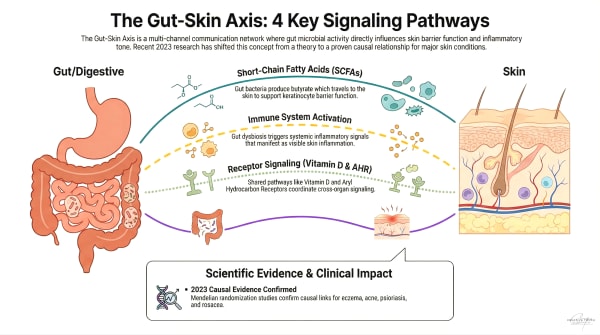
The causal direction of this relationship has been addressed by two Mendelian randomisation studies published in 2023. Mendelian randomisation uses genetic variants as natural experiments to test causal relationships. It is more robust than simple association studies. Both papers found evidence for causal relationships between gut microbiota composition and inflammatory skin conditions, including eczema, acne, psoriasis, and rosacea. [[15], [16]] This is encouraging, though it should be noted that the relationship is complex and confounded by shared environmental factors.
Notably, the axis works in both directions. Research cited in recent reviews suggests that skin injury can remodel the gut microbiome, confirming that the relationship runs in both directions.
For practical support, omega-3 fatty acids influence gut microbiome composition and support the fatty acid substrate pathway relevant to both gut and skin barrier function. Our Zinzino BalanceOil page discusses the omega-3 connection in detail. The role of vitamin B12 in skin cell regeneration and its relationship to inflammatory skin conditions is covered in our B12 and skin health article.
A full treatment of the gut-skin axis deserves its own article. This one will signpost rather than exhaust the topic. But if you’re dealing with persistent skin reactivity that doesn’t respond to topical approaches alone, it’s worth considering what’s happening further upstream.
Ageing, Hormones, and Your Microbiome
Frailty, not years, is the key variable
Too often, discussion on ageing and the microbiome tends to state that the microbiome “changes with age” and leave it there. The research picture is considerably more precise.
Research presented at the 2025 Science of Skin Summit, [17] drawing from high-depth DNA sequencing studies comparing younger adults, community-dwelling older adults, and frail older adults, found that physiological frailty, not chronological age, drives the most significant microbiome destabilisation. Frail skin showed increased community heterogeneity, reduced microbial resilience, and the highest burden of antibiotic resistance genes on skin surfaces. Chronological age produced less stark effects. A 2025 study confirmed that ageing-dependent skin microbiome changes are site-specific. The pattern differs significantly between face, arm, and trunk sites, with loss of Cutibacterium acnes dominance on the face in older skin being a notable marker. [18]
In one multi-study analysis presented at the 2025 Science of Skin Summit, drawing on data from over 650 women, increased skin microbiome diversity was actually associated with more lateral canthal lines and higher transepidermal water loss. This “hyperdiversity” of ageing skin may itself be a sign of community fragility rather than richness. The commensal community becomes less organised, less dominated by beneficial keystone species.
The practical reframe: this isn’t about age being a problem. It’s about understanding that as skin physiology changes, sebum production decreases, cell turnover slows, hydration gradients shift, and the microbial community changes with it, because the habitat has changed. That’s a reason to adjust your approach, not to panic.
The menopause microbiome window
Oestrogen decline during perimenopause and menopause affects the skin’s microbial community through at least three parallel pathways, and it’s worth presenting all three together because the combined picture is more clinically meaningful than any single mechanism.
First: oestrogen directly supports ceramide synthesis in the skin. Its decline reduces ceramide production independent of any microbial effect. Second: oestrogen supports filaggrin expression, another direct barrier protein effect. Third, and most specific to the microbiome: a 2024 pilot study of 44 women using 16S rRNA gene sequencing found that postmenopausal skin showed significantly reduced Lactobacillus abundance compared to premenopausal skin (Pagac et al. 2024). [19] The researchers propose this may reflect declining oestrogen reducing glycogen availability, the substrate Lactobacillus requires for growth, though this mechanism has not yet been directly measured in skin tissue. The finding warrants further investigation.
Lactobacillus contributes to skin acidification through antimicrobial metabolite production, so its reduction may add to the pH-maintenance challenges already created by the reduced C. acnes activity seen in older, less sebaceous skin.
The combined picture: menopause doesn’t just deplete one barrier component. It simultaneously reduces ceramide synthesis, reduces filaggrin expression, and alters the microbial community that maintains the acidic surface environment. That’s a genuinely useful frame for understanding why perimenopausal skin often changes in ways that seem disproportionate to what any single skincare adjustment can address. The research group behind the Pagac study specifically proposed that microbiome-targeted interventions may offer an alternative or adjunct to HRT for managing perimenopausal skin changes, something worth tracking as the evidence develops.
Professional Support for Microbiome Balance
Cold atmospheric plasma: the microbiome-rebalancing treatment
Most aesthetic descriptions of cold atmospheric plasma (CAP) focus on its general antimicrobial and anti-inflammatory properties. The specific microbiome data tells a more nuanced and more interesting story.
A 2025 clinical study used next-generation sequencing to examine microbiome composition before and after plasma treatment in ten patients with acne vulgaris and atopic dermatitis. [20] At 24 hours post-treatment, C. acnes decreased from 31.2% to 16.2%, S. aureus decreased from 4.2% to 2.1% in AD patients, whilst S. epidermidis increased from 10.8% to 11.7% across all patients. Critically, Simpson’s Index, a measure of microbiome diversity, significantly improved (P=0.045). This is a small study, and the S. epidermidis increase is modest in absolute terms, but the diversity improvement is the more clinically meaningful headline: the microbial community became more balanced, not just smaller.
A separate prospective pilot study of 22 patients with atopic dermatitis confirmed that CAP treatment significantly reduced the S. aureus proportion in lesional skin whilst improving clinical severity scores. [21]
The mechanism for this selectivity is worth understanding. CAP generates reactive oxygen and nitrogen species (RONS) that are particularly effective against S. aureus and its biofilm. Cold atmospheric plasma has demonstrated significant antibiofilm activity against S. aureus, achieving multi-log reductions in viable biofilm cells in laboratory studies. This is a promising finding for skin conditions where biofilm-forming bacteria contribute to chronic inflammation. [22] CAP also enhances macrophage killing of S. aureus, including antibiotic-resistant MRSA strains, through oxidative mechanisms. [23] A 2025 Frontiers in Bioengineering study confirmed that low-temperature cold plasma promotes wound healing by improving skin microbiome composition alongside reducing inflammation. [24]
There’s also a third mechanism worth noting. CAP treatment has also been shown to restore tight junction integrity in keratinocytes, a finding demonstrated in a 2022 study of psoriatic skin, which may support improved intercellular sealing in barrier-damaged tissue. [25] This gives CAP a three-channel approach to barrier restoration: antimicrobial selectivity, immune enhancement, and structural tight junction repair.
The key distinction from antibiotics is important here. Antibiotics reduce bacterial populations broadly. CAP appears to rebalance the commensal-to-pathogen ratio, reducing the pathogens whilst the commensals recover, rather than depleting the entire community.
For clients dealing with persistent skin issues where dysbiosis may be a factor, barrier damage with bacterial involvement, reactive skin that won’t settle despite consistent home care, cold atmospheric plasma treatment is one of the few clinic-based treatments that addresses the microbial environment directly, not just the inflammation it causes. These early studies are promising, but it’s important to be clear that larger randomised trials are needed to confirm the microbiome-rebalancing effect definitively.
LED light therapy as complementary support
Blue LED light at 415–420nm targets C. acnes through a specific mechanism: porphyrins are natural metabolic byproducts of C. acnes that act as endogenous photosensitisers, and blue light activates them to create reactive oxygen species within the bacterium. [26] This creates a relatively selective mechanism. Blue light disrupts acne-associated C. acnes overcolonisation without the broad-spectrum bacterial destruction of antibiotic treatments.
Red LED at 630–660nm works differently. It supports keratinocyte function and barrier repair through mitochondrial stimulation, indirectly supporting the microbiome habitat by restoring the barrier conditions that commensals require.
LED therapy doesn’t fundamentally rebalance dysbiosis in the way CAP does, but it modulates the microbial environment in a condition-specific way. It’s complementary to CAP for different presentations.
Treatments to time carefully
A few words on timing, because this applies to any treatment plan that includes active chemical or physical interventions.
Chemical peels cause temporary broad microbiome disruption, removing a layer of skin alongside the commensal community living on it. Recovery is the period when the microbiome re-establishes, and supporting that process with gentle cleansers, postbiotic moisturisers, and avoidance of antibacterial products during recovery makes biological sense.
Retinoids alter skin cell turnover and the surface environment in ways that can affect commensal populations during the adjustment period. Using microbiome-supportive products alongside retinoid introduction, particularly postbiotic formulas, may help smooth the adaptation phase.
The pattern across all active treatments is the same: the disruption phase is temporary, but what you do during recovery influences which bacteria repopulate and in what proportions.
Your Microbiome Is a Working Partner
The shift in framing that this article aims to leave you with is straightforward but significant. The microbiome is not a community you’re managing around your skincare. It’s a partner in your barrier’s ongoing maintenance, producing ceramides, training your immune defences, regulating surface pH, and controlling the tight junction architecture that determines how permeable your skin is.
Supporting it doesn’t require a complicated overhaul. The biggest levers are the most basic: a pH-balanced cleanser used at appropriate frequency, avoidance of daily antibacterial products where they’re not clinically necessary, and giving the surface environment the lipid substrates and minimal disruption it needs to function.
If your skin has been persistently reactive, sensitive, or slow to repair despite consistent home care, it may be worth exploring whether dysbiosis is part of the picture. A consultation can help map out the most appropriate approach, whether that’s adjusting your product choices, considering postbiotic support, or assessing whether a treatment like cold atmospheric plasma might address the microbial environment more directly.
Book a consultation with our team to discuss what’s happening with your skin.
Frequently Asked Microbiome Questions
- What exactly is the skin microbiome?
Your skin microbiome is the community of bacteria, fungi, and viruses that live on and within your skin’s surface. Far from being unwanted passengers, these microorganisms are active contributors to your skin’s health. Commensal bacteria help produce ceramides for your barrier, regulate surface pH to keep harmful bacteria out, and train your immune system to respond to threats without overreacting.
Your skin hosts hundreds of microbial species, with populations varying by body site – oily areas such as the face favour different organisms than dry or moist skin. The balance within this community, rather than the total number of microbes, matters most for your skin’s ongoing function.
- I’ve always tried to keep my skin clean and bacteria-free — am I doing the wrong thing?
Not entirely, but the goal of “bacteria-free” can work against you. Clean skin is important; sterile skin is not. The beneficial bacteria living on your skin, particularly Staphylococcus epidermidis, produce ceramides, manufacture antimicrobial peptides, and help maintain the acidic pH that protects you from genuinely harmful organisms.
Twice-daily cleansing with a gentle, pH-balanced formula keeps your skin clean whilst allowing your commensal community to function. The problem isn’t cleansing itself – it’s the combination of antibacterial products, high-frequency washing, and SLS-based formulas that removes helpful organisms without distinguishing them from harmful ones. If your current routine leaves your skin feeling tight, stripped, or reactive after cleansing, that’s a signal worth taking seriously.
- How can I restore and improve my skin microbiome?
The most effective starting point is removing what’s disrupting it. Switching from antibacterial soaps and SLS-based cleansers to a gentle, pH-balanced formula is the highest-impact daily change for most people.
What genuinely helps:
- pH-balanced cleansing — syndet (synthetic detergent) formulas maintain the acidic surface environment your commensals depend on
- Postbiotic moisturisers — bacterial metabolites with clinical evidence for barrier support, and stable enough through shelf life to actually deliver their effects
- Avoiding unnecessary antibacterial products — reserving them for clinical need rather than daily use
- Barrier lipid support — ceramide-rich moisturisers provide the substrate commensal bacteria require to thrive
Recovery from disruption is gradual (weeks rather than days), and longer for significantly imbalanced skin. If your skin remains persistently reactive despite consistent home care, it may be worth discussing whether a professional approach could address the microbial environment more directly.
- Are probiotic skincare products actually worth buying?
It depends which category you mean, and the marketing is muddled enough that this question genuinely matters.
Products labelled “probiotic” often contain lysates – fragments of dead bacteria – making them postbiotics by function even if not by name. Keeping live bacteria stable through a product’s shelf life is genuinely challenging, and many products cannot deliver what they imply.
Postbiotics (non-viable bacterial components and metabolites) are the most evidence-supported option currently available. Clinical studies confirm they can reduce transepidermal water loss and lower inflammatory markers including TNF-α and IL-1β. Prebiotics (substrates that selectively feed beneficial bacteria, such as inulin and glucomannan) are mechanistically sound but have less clinical trial data in skin applications to date.
The practical guidance: look for “postbiotic” on the label, or specific ingredients such as Vitreoscilla filiformis lysate, rather than assuming any “probiotic” claim means live bacterial activity.
- How does the menopause affect my skin’s microbiome?
Oestrogen decline during perimenopause and menopause affects your skin’s microbial community through several simultaneous pathways, which helps explain why skin changes during this period can feel disproportionate to any single skincare adjustment.
Oestrogen directly supports ceramide synthesis and filaggrin expression, so its decline affects the barrier immediately, independent of any microbial effect. Research also shows that postmenopausal skin contains significantly less Lactobacillus, a bacterium that contributes to maintaining your skin’s acidic pH – possibly because declining oestrogen reduces the glycogen substrate it depends on for growth.
The combined picture is a shift in barrier lipid environment and microbial community happening in parallel. Understanding this is not a reason for alarm, but it does explain why microbiome-supportive approaches such as postbiotic products, gentle cleansing, and barrier lipid replenishment, may be particularly valuable during this life stage. Researchers have specifically proposed microbiome-targeted interventions as a potential adjunct to HRT for managing perimenopausal skin changes, though larger studies are needed.
- Can I get my skin microbiome tested?
Consumer-facing skin microbiome testing does exist – DNA sequencing kits that sample your skin’s bacterial community – but there are important caveats before investing in one.
Skin microbiome composition varies significantly by body site, time of day, recent cleansing habits, and environmental conditions. A single snapshot may not reflect your stable baseline. More importantly, validated reference ranges for what a “healthy” skin microbiome looks like for your specific age, skin type, hormonal status, and geography are still being established by researchers. Interpreting results without that context is genuinely difficult.
At present, skin microbiome testing is most useful in a research context. For practical decisions about your skin, a detailed consultation covering your skin history, product use, reactivity patterns, and any existing conditions is likely to give more actionable information than a sequencing report alone.
- Cutibacterium acnes is linked to acne — so how can it also be beneficial?
The answer is context. Cutibacterium acnes is not inherently problematic, it’s an organism whose behaviour changes dramatically depending on its local environment.
In balanced skin, C. acnes metabolises sebum to produce propionic acid, which activates receptors that stimulate barrier lipid and filaggrin production, and maintains the acidic surface pH that keeps harmful bacteria from establishing a foothold. It plays a genuine role in your barrier’s maintenance chemistry.
It’s when follicles become blocked, altering the local oxygen levels and pH, that the same organism contributes to inflammation. The environment changes; the organism responds accordingly.
This distinction matters practically. Broad-spectrum treatments that eliminate C. acnes entirely may remove a key barrier signal alongside the acne driver. Targeted approaches that address the follicular environment tend to be more precise. This is worth discussing with a clinician if you’re on long-term topical antibiotic treatment.
- My eczema doesn’t improve despite regular moisturising — could my skin microbiome be involved?
Almost certainly involved, though the relationship runs in both directions. Eczema-affected skin consistently shows reduced microbial diversity, with Staphylococcus aureus dominating at the expense of protective commensals like S. epidermidis.
This isn’t coincidental. S. aureus produces enzymes that degrade filaggrin (a key structural barrier protein) and eliminates the antimicrobial defences that would otherwise control it. Barrier dysfunction in turn raises surface pH in ways that further favour S. aureus. The two processes amplify each other in a self-reinforcing cycle.
People with filaggrin gene variants, which are common in atopic dermatitis, appear particularly susceptible to this loop. Mendelian randomisation studies have also provided evidence for a causal relationship between gut microbiota composition and eczema risk, adding a further dimension.
If standard emollients aren’t providing sufficient relief, it’s worth discussing whether microbiome-targeted approaches – postbiotic products, gentle cleansing, or clinic-based treatments such as cold atmospheric plasma – could support your management plan alongside existing treatment. Please continue any prescribed treatments and speak to your GP or dermatologist before making changes.
References
Zheng, Y., Hunt, R., Villaruz, A., Fisher, E., Liu, R., Liu, Q., Cheung, G., Li, M., Otto, M. (2022). Commensal Staphylococcus epidermidis contributes to skin barrier homeostasis by generating protective ceramides. Cell Host & Microbe, 30(3), 301-313.e9. doi.org/10.1016/j.chom.2022.01.004
doi: 10.1016/j.chom.2022.01.004Dimmers, F., Reichert, D., Nguyen, T., Lück, N., Ramachandran, H., Bremges, A., Schild, J., Humbek, M., Grether-Beck, S., Rossi, A., Staerk, C., Esser, C., Krutmann, J. (2026). Monocentric, vehicle-controlled, double-blind study to assess the short- and long-term effects of a Ceramide NP C15-containing emollient on the skin microbiome and the skin barrier function in sensitive skin. Skin pharmacology and physiology, (), 1-30. doi.org/10.1159/000551043
doi: 10.1159/000551043Pastar, I., O’Neill, K., Padula, L., Head, C., Burgess, J., Chen, V., Garcia, D., Stojadinovic, O., Hower, S., Plano, G., Thaller, S., Tomic-Canic, M., Strbo, N. (2020). Staphylococcus epidermidis Boosts Innate Immune Response by Activation of Gamma Delta T Cells and Induction of Perforin-2 in Human Skin. Frontiers in Immunology, 11(), . doi.org/10.3389/fimmu.2020.550946
doi: 10.3389/fimmu.2020.550946Qi, P., Gong, F., Leng, M., Wei, Z. (2025). Beneficial perspective on Staphylococcus epidermidis: a crucial species for skin homeostasis and pathogen defense. Frontiers in Immunology, 16(), . doi.org/10.3389/fimmu.2025.1674392
doi: 10.3389/fimmu.2025.1674392Almoughrabie, S., Cau, L., Cavagnero, K., O’Neill, A.M., Li, F., Roso-Mares, A., Mainzer, C., Closs, B., Kolar, M.J., Williams, K.J., Bensinger, S.J., Gallo, R.L. (2023). Commensal Cutibacterium acnes induce epidermal lipid synthesis important for skin barrier function. Science advances, 9(33), eadg6262. doi.org/10.1126/sciadv.adg6262
doi: 10.1126/sciadv.adg6262Lyu, Y., Shen, J., Che, Y., Dai, L. (2025). Skin microbiome engineering: Challenges and opportunities in skin diseases treatment. iMetaOmics, 2(2), e70012. doi.org/10.1002/imo2.70012
doi: 10.1002/imo2.70012Kim, H.B., Alexander, H., Um, J.Y., Chung, B.Y., Park, C.W., Flohr, C., Kim, H.O. (2025). Skin Microbiome Dynamics in Atopic Dermatitis: Understanding Host-Microbiome Interactions. Allergy, asthma & immunology research, 17(2), 165-180. doi.org/10.4168/aair.2025.17.2.165
doi: 10.4168/aair.2025.17.2.165Williams, M.R., Gallo, R.L. (2017). Evidence that Human Skin Microbiome Dysbiosis Promotes Atopic Dermatitis. The Journal of investigative dermatology, 137(12), 2460-2461. doi.org/10.1016/j.jid.2017.09.010
doi: 10.1016/j.jid.2017.09.010Nath, S., Kumari, N., Bandyopadhyay, D., Sinha, N., Majumder, P.P., Mitra, R., Mukherjee, S. (2020). Dysbiotic Lesional Microbiome With Filaggrin Missense Variants Associate With Atopic Dermatitis in India. Frontiers in cellular and infection microbiology, 10(), 570423. doi.org/10.3389/fcimb.2020.570423
doi: 10.3389/fcimb.2020.570423Bobok, N., Taskesen, T. (2025). Stress-Induced Changes of the Skin: A Narrative Review. Cureus, 17(11), e96285. doi.org/10.7759/cureus.96285
doi: 10.7759/cureus.96285Prajapati, S.K., Lekkala, L., Yadav, D., Jain, S., Yadav, H. (2025). Microbiome and Postbiotics in Skin Health. Biomedicines, 13(4), . doi.org/10.3390/biomedicines13040791
doi: 10.3390/biomedicines13040791Hashemi, S.S., Rafati, A., Roohinejad, S., Yaghoobi, F., Salehi, A. (2025). Postbiotics as Emerging Therapeutics for Skin Wound Healing and Dermatological Care: Clinical Trends and Mechanistic Insights. International wound journal, 22(12), e70799. doi.org/10.1111/iwj.70799
doi: 10.1111/iwj.70799Russell, M.F., Sandhu, M., Vail, M., Haran, C., Batool, U., Leo, J. (2024). Tallow, Rendered Animal Fat, and Its Biocompatibility With Skin: A Scoping Review. Cureus, 16(5), e60981. doi.org/10.7759/cureus.60981
doi: 10.7759/cureus.60981Jimenez-Sanchez, M., Celiberto, L., Yang, H., Sham, H., Vallance, B. (2025). The gut-skin axis: a bi-directional, microbiota-driven relationship with therapeutic potential. Gut Microbes, 17(1), . doi.org/10.1080/19490976.2025.2473524
doi: 10.1080/19490976.2025.2473524Long, J., Gu, J., Yang, J., Chen, P., Dai, Y., Lin, Y., Wu, M., Wu, Y. (2023). Exploring the Association between Gut Microbiota and Inflammatory Skin Diseases: A Two-Sample Mendelian Randomization Analysis. Microorganisms, 11(10), . doi.org/10.3390/microorganisms11102586
doi: 10.3390/microorganisms11102586Mao, R., Yu, Q., Li, J. (2023). The causal relationship between gut microbiota and inflammatory dermatoses: a Mendelian randomization study. Frontiers in immunology, 14(), 1231848. doi.org/10.3389/fimmu.2023.1231848
doi: 10.3389/fimmu.2023.1231848PracticalDermatology (2025). Skin Microbiome and Aging: Connected for the Long Haul?. PracticalDermatology. practicaldermatology.com/…e-long-haul/2483286/ (Accessed: 2026-03-23)
Swaney, M.H., Newman, D.J., Mao, J., Hilton, A.C., Worthington, T., Li, M. (2025). Aging-dependent skin microbiome alterations across body sites in a United Kingdom cohort. Frontiers in aging, 6(), 1644012. doi.org/10.3389/fragi.2025.1644012
doi: 10.3389/fragi.2025.1644012Pagac, M.P., Stalder, M., Campiche, R. (2024). Menopause and facial skin microbiomes: a pilot study revealing novel insights into their relationship. Frontiers in aging, 5(), 1353082. doi.org/10.3389/fragi.2024.1353082
doi: 10.3389/fragi.2024.1353082Watanabe, C. (2025). Plasma Treatment – Results of Skin Microbiome Analysis. Clinical, Cosmetic and Investigational Dermatology, Volume 18(), 1269-1279. doi.org/10.2147/CCID.S482265
doi: 10.2147/CCID.S482265Kim, Y.J., Lim, D.J., Lee, M.Y., Lee, W.J., Chang, S.E., Won, C.H. (2021). Prospective, comparative clinical pilot study of cold atmospheric plasma device in the treatment of atopic dermatitis. Scientific reports, 11(1), 14461. doi.org/10.1038/s41598-021-93941-y
doi: 10.1038/s41598-021-93941-yLunder, M., Dahle, S., Fink, R. (2024). Cold atmospheric plasma for surface disinfection: a promising weapon against deleterious meticillin-resistant Staphylococcus aureus biofilms. The Journal of hospital infection, 143(), 64-75. doi.org/10.1016/j.jhin.2023.10.014
doi: 10.1016/j.jhin.2023.10.014Duchesne, C., Frescaline, N., Blaise, O., Lataillade, J.J., Banzet, S., Dussurget, O., Rousseau, A. (2021). Cold Atmospheric Plasma Promotes Killing of Staphylococcus aureus by Macrophages. mSphere, 6(3), 101128msphere0021721. doi.org/10.1128/mSphere.00217-21
doi: 10.1128/mSphere.00217-21Zhou, J., Sun, Z., Wang, X., Wang, S., Jiang, W., Tang, D., Xia, T., Xiao, F. (2025). Low-temperature cold plasma promotes wound healing by inhibiting skin inflammation and improving skin microbiome. Frontiers in Bioengineering and Biotechnology, 13(), . doi.org/10.3389/fbioe.2025.1511259
doi: 10.3389/fbioe.2025.1511259Kim, N., Lee, S., Lee, S., Kang, J., Choi, Y.A., Park, J., Park, C.K., Khang, D., Kim, S.H. (2022). Portable Cold Atmospheric Plasma Patch-Mediated Skin Anti-Inflammatory Therapy. Advanced science (Weinheim, Baden-Wurttemberg, Germany), 9(34), e2202800. doi.org/10.1002/advs.202202800
doi: 10.1002/advs.202202800Hernández-Bule, M.L., Naharro-Rodríguez, J., Bacci, S., Fernández-Guarino, M. (2024). Unlocking the Power of Light on the Skin: A Comprehensive Review on Photobiomodulation. International journal of molecular sciences, 25(8), . doi.org/10.3390/ijms25084483
doi: 10.3390/ijms25084483