

Does Your Skin Dream of Smoother Shores?
Tired of waging a losing battle against stubborn pockets of excess skin? Are your eyelids at the mercy of gravity or are laughter lines mocking your efforts? Loose neck skin betraying you more assuredly than a Voight-Kampff test? We’ve all experienced the frustration of skin that doesn’t quite reflect our youthful spirit and perception of ourselves.
Our Plasma Fibroblast skin tightening treatment is the future of rejuvenation, allowing us to remove excess skin from the face and create a much smoother and more youthful appearance. The results can be truly amazing.
Many refer to it as ‘soft surgery’ due to the reduced downtime following the treatment and the astonishing results that we can produce.
What areas of the body can be treated?
Whether you suffer from excess skin around the eyes, jowl or mouth area (to name a few) we can adapt this treatment to rid you of the excess skin and allow for a tightening effect.
We can treat various areas of the body, depending entirely on the suitability of the client and the skin type. Areas such as bingo wings, ear lobes and kneecaps can be great candidates for this treatment.
We can remove skin tags, milia, cholesterol dots, and benign moles and improve the appearance of stretch marks and sun spots.
Plasma Skin Tightening is a wonderfully versatile treatment that can correct and improve many skin problems. Our friendly team will discuss with you what you are hoping to achieve from your treatment, and we will work with you to get the result you are looking for.
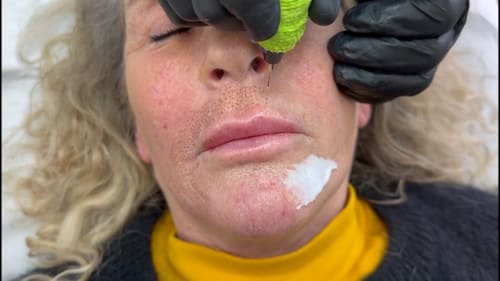
What is Plasma?
Plasma is frequently called “the fourth state of matter”, following solid, liquid and gas. Plasma is made when electrostatic energy is combined with ionised gas. When the thermal energy that is produced reaches around 1mm from the treatment area, it creates a plasma arc due to the combination of oxygen and atmospheric nitrogen.
How does it revitalise the skin?
This arc creates what is referred to as ‘minor trauma’ and the immediate contraction of the skin tissue. Carbon crusts are created as a result of this and the dehydration of the skin. These crusts will fall off, typically betweentodays, and leave the skin surface rejuvenated.
This type of trauma caused to the epidermis creates a response by the body, producing new elastin, collagen and protein fibres and improving blood circulation to the treatment area.
Aftercare advice
During the healing process, we encouraged clients to allow the skin to heal naturally without using topical products, which may hydrate, causing the skin to hold on to the carbon crusts longer than required.
Once the crusts have fallen, use a high-factor SPF covering to protect the skin from any risks of pigmentation and/or sun damage. Whilst this treatment may not directly cause this, it can increase the chances of this happening following sun exposure if the correct precautions are not taken during the aftercare.