

Have you ever noticed a tiny, fleshy bump hanging off your skin? Don’t panic! Those are likely skin tags, and here at Creative Touch in Rotherham, we know they’re more common than you might think.
Our team can quickly and safely remove these blemishes, and we’re always keen to share our expertise.
Beyond the appearance of skin tags, understanding what causes them to appear can offer fascinating insights into overall health.
Our experience at Creative Touch helps shed some light on these connections.
What Exactly Are Skin Tags?
Medically known as acrochordons, skin tags are small, soft, skin-coloured or brownish growths that typically hang by a tiny stalk.
These benign cutaneous growths are composed of excess collagen fibres and blood vessels. While typically 1-5mm, they can occasionally grow larger.
Skin tags can appear anywhere on the body but are most commonly found in areas where skin rubs against skin or clothing, such as the neck, armpits, groin, under the breasts, and on the eyelids.
At our Rotherham clinic, the Creative Touch team regularly sees clients concerned about these common growths and understands how they can impact comfort and confidence.
Recent population studies reveal striking prevalence patterns:
- Around 30% of the general population develops skin tags. [1]
- 95% of affected individuals have at least one associated metabolic condition. [1]
- There’s a 66% occurrence in obese patients versus 48.3% in normal-weight individuals. [2]

The Deeper Science: Why Do Skin Tags Appear?
The exact cause of skin tags may not be fully understood. Extensive research, supported by our clinic’s experience, points to a combination of factors.
Genetic Predisposition: Unravelling Your Family’s Skin Story
Skin tags often exhibit a familial pattern, indicating a genetic predisposition. This means that if close relatives have skin tags, you may be more susceptible to developing them yourself.
This familial link suggests that genetics can establish a baseline susceptibility, effectively acting as a risk multiplier. When this inherent predisposition combines with environmental or physiological triggers such as friction, hormonal changes, or metabolic imbalances, the likelihood of skin tag formation increases.
While most skin tags are benign, they can sometimes be a feature of rare genetic syndromes, such as Birt-Hogg-Dube (BHD) syndrome and Tuberous Sclerosis, often alongside other distinct features. However, it’s important to clarify that these syndromes are uncommon, and the vast majority of skin tags are not associated with such conditions.
While commonly associated with middle and older age, studies report an increasing incidence in children and adolescents, a trend in concert with the global rise in childhood and teenage obesity. This observation suggests a powerful interaction: a genetic predisposition might be present, but early-life obesity can accelerate the manifestation of skin tags at a younger age.
Genetics may play a role, but lifestyle choices and environmental factors significantly influence the appearance of skin tags.
This understanding highlights the importance of early health interventions, as skin tags can serve as an early indicator of metabolic health issues in younger individuals.
Friction and Irritation: Mechanical Stress on Your Skin
Skin tags commonly develop in areas of repeated rubbing or chafing, such as the neck, armpits, and groin. This constant friction can irritate. In some cases, it leads to bleeding or itching.
Individuals who are overweight or obese are particularly prone to skin tags due to an increase in skin folds, which naturally lead to more friction.
The formation of skin tags due to friction involves several cellular mechanisms.
- Mechanical trauma or repeated friction triggers a localised cellular response.
- This irritation leads to the recruitment of specialised immune cells called mast cells to the affected site.
- These mast cells then release various mediators, including Tumor Necrosis Factor-alpha ( TNF-α) and tryptase.
- These substances stimulate fibroblasts (which produce collagen) and keratinocytes (the primary cells of the epidermis).
- This stimulation promotes their proliferation and the excessive deposition of collagen, ultimately leading to the formation of skin tags.
Friction is not merely a physical irritant; it is a biological trigger that initiates a cellular cascade for growth.
Furthermore, the observation that friction is particularly problematic for obese individuals highlights a synergistic effect. Obesity increases the number of areas prone to friction due to the greater number of skin folds. It also increases the likelihood of underlying metabolic issues, such as insulin resistance and chronic inflammation, which independently promote skin cell growth.
An obese individual, therefore, faces both a higher physical predisposition to friction and a heightened biological readiness to respond to that friction with skin tag formation.
This reinforces our advice to maintain a healthy weight. It addresses both metabolic factors and directly mitigates the friction-induced mechanism.
Additionally, the normal ageing process and associated loss of skin elasticity can make skin more susceptible to friction-induced tags.
Hormonal Shifts: A Closer Look at Pregnancy and Beyond
Skin tags are common during pregnancy - a period characterised by significant hormonal fluctuation. Specifically, increased levels of estrogen and progesterone may promote skin cell growth during this time.
A reassuring aspect for pregnant individuals is that skin tags developed during pregnancy may naturally resolve or fall off after childbirth as hormone levels return to normal.
Our team at Creative Touch understands, from our work with clients across South Yorkshire, that pregnancy brings many changes, and skin tags can certainly be one of them. It’s fascinating to see the science behind these temporary shifts, and our clinic is prepared to guide clients through these concerns.
Scientific studies reveal that skin tags exhibit significantly higher levels of estrogen receptors (ERα, ERβ) and androgen receptors (AR) compared to normal skin. Cells within skin tags are highly responsive to these sex hormones.
These estrogen and androgen receptors can influence the activity of keratinocytes and fibroblasts, crucial for skin tissue formation, as well as mast cells, further contributing to skin tag development.
Increased androgen levels, often observed in hormonal disorders such as Polycystic Ovary Syndrome (PCOS), are also linked to skin tag development.
In obese individuals, hyperandrogenism can additionally result from hyperinsulinemia, creating a complex interplay of metabolic and hormonal factors.
The observation that skin tag development tends to slow or cease around menopause and andropause (typically around age 50) further supports the hormonal link, as this period correlates with a decrease in sex steroid receptors.
The data reveals a complex, interconnected system where hormonal, metabolic, and inflammatory pathways converge.
- Pregnancy can lead to both hormonal changes and temporary insulin resistance.
- Obesity can lead to hyperinsulinemia, which in turn can cause hyperandrogenism, promoting skin tag growth.
- Hormones like estradiol can increase mast cell counts, potentially amplifying the friction-induced mechanism.
This interconnectedness means that a change in one area, such as insulin sensitivity, can cascade through hormonal and inflammatory pathways to influence the formation of skin tags.
An holistic approach to health can positively impact hormonal balance and reduce inflammation through diet and exercise. This potentially reduces skin tag formation by improving underlying metabolic health, even if the primary driver appears to be hormonal.
The Metabolic Connection: Insulin Resistance and Beyond
There is a strong association between skin tags and conditions such as obesity, diabetes, and metabolic syndrome (MeTS). Other associated conditions include abnormal lipid profiles and hypertension.
At our Rotherham clinic, discussions often revolve around how skin tags can be a surprising indicator of underlying metabolic health. It’s a conversation we approach with sensitivity and expertise.
The core mechanism linking skin tags to metabolic health involves insulin resistance and hyperinsulinemia. Insulin resistance occurs when the body’s cells do not respond effectively to insulin, prompting the pancreas to produce more insulin (a state known as hyperinsulinemia) to regulate blood sugar.
High circulating insulin levels can cross-react with the Insulin-like Growth Factor-1 (IGF-1) receptor found on skin cells, specifically keratinocytes and dermal fibroblasts. This activation stimulates the rapid proliferation and growth of these skin cells, directly contributing to skin tag formation.
Furthermore, excess insulin can lead to the release of more free IGF-1 into the bloodstream, amplifying this growth signal and promoting the formation of loose connective tissue.
The consistent emergence of IGF-1 as a key player across hormonal and metabolic causes suggests that while initial triggers may vary, they often converge on common growth factor pathways, particularly involving IGF-1, to drive skin tag formation. This provides a deeper scientific foundation for why various seemingly disparate factors can all lead to the same outcome.
The presence of skin tags, particularly numerous ones or in overweight/obese individuals, can serve as an easily identifiable clinical marker or external sign for underlying insulin resistance or an increased risk of developing prediabetes, type 2 diabetes, and even cardiovascular disease.
This elevates skin tags from a mere cosmetic nuisance to a potentially significant diagnostic clue, transforming the conversation from just removal to broader health awareness.
Creative Touch aims to position itself as an aesthetics clinic and a partner in holistic well-being, encouraging clients to discuss these observations with their healthcare provider.
Additionally, hyperinsulinemia and IGF-1 can induce the ovaries to produce excess androgens, further linking metabolic health to hormonal imbalances.
Chronic inflammation, a hallmark of insulin resistance, may also contribute to the growth of skin tags. Inflammatory markers have been detected in skin tag tissue.
Clinical Implications: When Tags Signal Deeper Issues
Skin tags demonstrate diagnostic value, particularly as markers for metabolic syndrome:
| Metabolic Parameter | Correlation Strength (OR) |
|---|---|
| Obesity | 3.2 |
| Type 2 Diabetes | 2.8 |
| Hypertension | 2.1 |
| Dyslipidemia | 1.9 |
Patients with 10 or more skin tags should consider testing for fasting glucose/HbA1c, a lipid profile, and blood pressure monitoring.
Ready to Reclaim Smooth Skin? Your Creative Touch Removal Options
If skin tags bother you, getting them removed is a simple and safe process. Our experienced team ensures that each removal is performed carefully, reducing the risk of scarring or recurrence, and providing peace of mind. We offer various effective options:
- Cryotherapy: This method involves freezing the tag with liquid nitrogen.
- Excision: A quick and effective method where the tag is snipped off with a tiny, sterile scalpel.
- Ligation: The blood supply to the tag is tied off, causing it to wither and fall off.
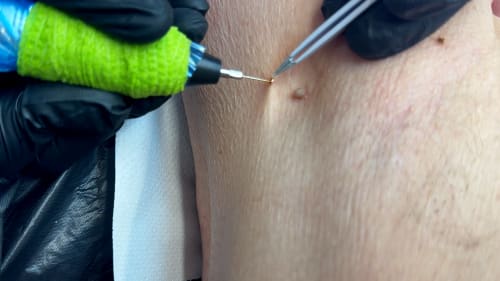
- Plasma: Using the Plasma Pen, our team can painlessly sever the tag at the skin surface.
Precision techniques minimise the potential for scarring; however, the likelihood of a scar depends on factors such as the size and depth of the growth and individual skin type. Most removals are completed in under an hour. The type and number of growths being treated can sometimes mean that it takes longer.
Investment in Smooth Skin: Our Pricing
The good news is that skin tag removal is not expensive. Our prices start at £50 for the first 3 skin tags and then £10 each.

Proactive Skin Health: Minimising Your Chances, Our Rotherham Advice
Complete prevention of skin tags cannot be guaranteed, but proactive steps can significantly minimise their chances of development. As trusted skin health partners in Rotherham, Creative Touch believes in empowering individuals to improve their well-being.
Maintain a Healthy Weight: Research consistently highlights the strong link between excess weight, metabolic health (including insulin resistance, hyperinsulinemia, and IGF-1 activation), and the prevalence of skin tags. Managing weight effectively not only reduces the number of skin folds but also, consequently, the friction that contributes to the development of skin tags. This advice extends beyond mere skin tag prevention; it represents a holistic health strategy with far-reaching benefits for overall well-being, including reduced risk of conditions such as diabetes and cardiovascular disease.
Keep it Loose: Avoiding tight clothing or jewellery that constantly rubs against the skin directly mitigates the friction mechanism, which involves mast cell activation and subsequent collagen deposition. Opting for loose, breathable fabrics can significantly decrease skin irritation.
Practice Good Hygiene: Regularly washing and thoroughly drying the skin, especially in areas prone to friction and moisture, is vital for maintaining overall skin health and preventing irritation.
Keep an Eye Out: Self-examination of the skin for any new growths allows for early detection and potential removal before they become larger or more bothersome.
Special Note for Pregnancy: For our pregnant clients, remember that many skin tags that appear during pregnancy may naturally resolve or fall off after childbirth as hormone levels return to normal.
When to Seek Professional Advice
While skin tags are typically harmless, we recommend consulting a professional if they cause discomfort, change their appearance, or if a significant number of them develop.
Given the established link between skin tags and metabolic health, particularly insulin resistance, obesity, and metabolic syndrome, their presence can serve as a valuable opportunity to discuss overall health with a healthcare professional. This can prompt consideration of a check-up for potential insulin resistance or related conditions.
At Creative Touch, our focus extends beyond aesthetics to overall well-being. We encourage individuals to view skin tags as a potential conversation starter with their general practitioner about metabolic health.
A professional evaluation is advised if a skin tag becomes painful, bleeds, changes colour, or grows rapidly, to rule out other skin conditions that may require different management.
Your Trusted Skin Health Partner in Rotherham
Skin tags - often perceived as mere cosmetic nuisances - offer a fascinating glimpse into the intricate workings of the human body. Their formation is not a singular event but a complex interplay of genetic predispositions, mechanical friction, hormonal fluctuations, and, significantly, underlying metabolic health.
Understanding these multi-factorial origins, from the cellular cascade triggered by friction to the systemic impact of insulin resistance and growth factors, empowers individuals to take proactive steps for their skin health and overall well-being.
Our Creative Touch team is dedicated to helping clients achieve smooth, blemish-free skin.
Aside from providing safe and effective removal options, our clinic encourages clients to develop a broader understanding of the implications of skin health and overall well-being.
The journey to confident, healthy skin starts with understanding, and Creative Touch is committed to supporting clients every step of the way.
References
Abdel-Rahman, A., Elsaied, S., Mohammed, S. (2023). Prevalence, clinical criteria, and risk factors of skin tags. Journal of the Egyptian Women’s Dermatologic Society, 20(2), 106-113. doi.org/10.4103/jewd.jewd_52_22
doi: 10.4103/jewd.jewd_52_22Sari, F., Inci, A., Dolu, S., Sari, R. (2017). Skin tags associated with obesity and diabetes mellitus in patients with chronic kidney disease. Srpski arhiv za celokupno lekarstvo, 145(11-12), 589-592. doi.org/10.2298/SARH160721158S
doi: 10.2298/SARH160721158S