
What’s in this audio? (Click to expand)
- The 4pm Biscuit Tin: The relatable office scenario — a craving hits at 3-4pm despite a proper lunch, bringing guilt and a familiar willpower narrative we are here to dismantle.
- Your Body’s Internal Clock: How the SCN master clock in the hypothalamus coordinates biological timing across every organ, and why roughly 15% of human genes are expressed rhythmically throughout the day.
- Cortisol’s Daily Arc: How the alertness hormone surges at dawn then drops to its daily physiological floor by mid-afternoon — the exact window that gave us the siesta and afternoon tea.
- The Perfect Storm: Why 4pm specifically — the precise convergence of falling cortisol, a rising circadian appetite drive, and a postprandial glucose crash all landing at the same moment.
- The Two Lunches: A white wrap versus chicken and lentils — same calories, radically different metabolic outcomes — exploring the food matrix concept and how an insulin overshoot creates the afternoon crash three hours later.
- Inside the Brain: The Lenners 2013 fMRI trial showing 8.2% greater nucleus accumbens activation after a high-GI meal, and why the compulsion is metabolic rather than sensory — even when both meals taste identical.
- Starving in a Sea of Energy: How a surge of insulin triggers malonyl-CoA to lock the CPT1 fat-burning gate on mitochondria, and how chronic ultra-processed diets degrade astrocyte signalling in the brain itself.
- Three Practical Interventions: Preserving the food matrix at lunch, avoiding the fat-plus-refined-carb UPF combination, and the cellular mechanism by which a 10-minute walk chemically unlocks your fat cells via AMPK.
- The Long Game: How repeated daily glucose crashes progressively down-regulate dopamine D2 receptors over years, the GLP-1 medication context, and a simple practical experiment to run tomorrow.
You ate lunch. A proper one. Not a rushed sandwich over your keyboard, but something that genuinely felt like a meal. And yet, somewhere between half three and four in the afternoon, something shifts. Not quite hunger. More like an urgent, slightly irrational pull toward biscuits, a cereal bar, or whatever’s in the kitchen. You weren’t even thinking about food, and then suddenly you very much are.
You manage it, or you don’t. Either way, there’s often a sense that you should have more control over this.
You don’t lack willpower. What you’re experiencing is the collision of three biological systems, all hitting a low point at roughly the same time of day. Understanding why this happens, at the level of actual brain chemistry and cellular metabolism, is a lot more useful than being told to “eat more protein” or “cut back on sugar.”
Let’s break this down and see how these systems interact.
We dive into the “perfect storm” that occurs when your natural daily cortisol dip aligns with a blood sugar crash caused by high-GI lunches like white bread or pasta. How does the quality of your midday meal, not just the calories, fix your “fuel switch” and keep your energy stable until dinner?
View Full Transcript
All right, let’s talk about something that I’m willing to bet is very, very familiar to a lot of you. It’s that moment right around 4 p.m. when you feel this almost magnetic pull towards the biscuit tin. I mean, you’ve had a proper lunch, right?
You felt full, you were getting on with your work, and then bam, like clockwork, it hits. It’s not just that you’re a bit peckish, it’s this urgent, almost desperate need for something sweet or carby. So what’s going on?
You know, this quote just hits the nail on the head, doesn’t it? It’s not normal hunger. It feels, well, it feels different.
More demanding, a bit irrational. Well, it turns out that feeling is incredibly real, and there’s a solid biological reason behind it. And this is the most important thing to get straight from the off.
If this happens to you, it has nothing to do with a lack of willpower. Seriously, what you’re feeling is a completely predictable physiological event, not some kind of personal failing. Okay, so let’s properly dive into this 4 p.m. feeling.
We’re gonna unpack exactly what is happening inside your body at that specific time of day. That craving you feel isn’t just random. Think of it as a perfect storm.
It’s the moment where three different things – your body’s natural daily clock, your hormones, and the fallout from your lunch – all crash into each other. So let’s break down these three culprits, shall we? We’ll look at them one by one and see exactly how they set you up for that afternoon energy slump.
Okay, take a look at this. This timeline really lays it all out. Say you have a high-glycaemic lunch.
We’re talking things like a white bread sandwich, white pasta, that kind of thing. It causes a massive, fast spike in your blood sugar. Now, at the exact same time, your body’s natural level of cortisol, that’s our main alertness hormone, is already on its way down for the day.
And then around 4 p.m., these two lines cross. Your blood sugar crashes just as your cortisol hits rock bottom. Your body basically sends out an emergency signal.
So just to quickly pull that all together, you’ve got the backdrop, which is your body’s natural rhythm. You’ve got the trigger, which is that high-GI lunch. And then you get the crash, where those two things collide.
And your brain just screams, find me some sugar. Right now. And look, this isn’t just a nice theory.
We can actually see this happening. Thanks to some really fascinating brain scan research, we can watch what your brain is doing at that exact moment. So get this.
In a landmark study from 2013, researchers gave a group of men two different meals. Now, critically, they had the exact same number of calories and were rated as being equally tasty. The only real difference was how quickly the carbs hit their bloodstream.
And as you can see from this graph, four hours after that high-GI meal, their blood sugar had absolutely plummeted and their hunger levels had shot right up. But here, right here, is the smoking gun. At that same four-hour point, they scanned everyone’s brains.
And this image shows you exactly what they found. After the high-GI meal, one specific bit of the brain lit up like a Christmas tree. That bright spot?
That’s the nucleus accumbens, which is basically the brain’s main hub for reward and craving. And we’re not talking about a vague feeling here. The effect was incredibly precise.
They measured an 8.2% increase in blood flow directly to that craving centre. This was a physical, quantifiable neurological event. So let’s be absolutely clear on what this means.
The two meals tasted the same. This proves that the intense craving for food wasn’t about pleasure or taste. It was the direct metabolic consequence of what was happening in their blood hours after they’d finished eating.
Right, but this brings up a massive question, doesn’t it? If your blood sugar is so low, why doesn’t your body just, you know, burn some of its fat stores for energy? Why is it suddenly an emergency?
Well, the answer lies in something called the Randle Cycle. The simplest way to think about it is as your body’s fuel switch. It’s a really clever system designed to shift from burning carbs when they’re around to burning fat when they’re not.
The problem is, that high-GI lunch completely jams the switch. The huge spike in insulin basically tells your cells to lock the gate to your fat stores. So four hours later, when the sugar from your lunch has all been used up, the gate to your fat reserves is still locked shut.
You’re stuck in a fuel crisis. There’s no sugar left and you can’t access your fat. You know, this famous line from the Rime of the Ancient Mariner just sums it up perfectly.
Your body is floating on an ocean of energy, in your fat stores, enough to last for weeks, but it can’t access a single drop. And that is the crisis that triggers that desperate, urgent craving. So the big question is, how do we fix this?
Well, the key isn’t about eating less. It’s about choosing the right kind of lunch. One that doesn’t jam that fuel switch in the first place.
Really, your choice at midday sets you off down one of two completely different paths for the afternoon. One path leads straight to that 4pm crisis, while the other gives you smooth, stable energy all the way through till dinner. And just look at this comparison here.
Both of these lunches have the exact same number of calories, but the high-GI lunch, your white-wrap say, causes that huge spike and the inevitable 4-hour crash, which lights up your brain’s reward centre. Now contrast that with the low-GI lunch, like some chicken and veg, you get a nice, gradual energy release, your blood glucose stays stable, and come 4pm, you just feel normal. Your appetite is calm and manageable.
It just proves it. It’s the quality of the food, not the calorie count, that dictates what happens later. So let’s bring this all home.
That 4pm craving? It’s not a moral failing. It’s not a test of your character.
Think of it as data. It’s simply your body’s incredibly accurate reporting system telling you exactly what it thought of your last meal. So the next time that feeling strikes, just pause for a second and ask yourself this.
Is this just a random attack of the munchies, or is it actually a direct biological message sent from my lunch asking me to maybe make a different choice tomorrow?
Why It’s 4pm and Not 2pm or 7pm
The timing isn’t random.
Human appetite follows a circadian rhythm, with its lowest point in the morning and a progressive increase throughout the day. [1] This pattern is governed by the body’s master clock, a cluster of neurons in the hypothalamus (an area at the base of the brain) called the suprachiasmatic nucleus (SCN). The SCN coordinates biological timing across virtually every organ and tissue in the body. Approximately 15% of all human genes are expressed rhythmically across the day, [1] and hunger is among the most strongly patterned of all biological drives.
Cortisol, the body’s primary alertness and glucose-mobilising hormone, follows a well-characterised daily arc, established across decades of chronobiological research. It peaks in the early morning, providing the energy and focus needed to start the day, then gradually declines. By early to mid-afternoon, it hits a natural trough. This is physiologically normal, not a malfunction. Many cultures have historically built afternoon rest periods around exactly this biological reality.

In a metabolically healthy individual eating whole, unprocessed foods, this cortisol dip is barely noticeable. Fat oxidation maintains relatively stable energy, the fuel-switching system operates cleanly, and the dip passes without drama.
But when a high-glycaemic lunch is added to this circadian pattern, something different happens. The circadian data from McHill & Butler (2024) place the peak of appetite at approximately 20:00, with a trough around early morning. Through the afternoon, appetite is on an ascending slope, not yet at its peak. That ascending circadian drive creates the backdrop. What turns it into a crisis is the postprandial glucose crash from lunch, typically arriving three to five hours after eating, landing on exactly that rising afternoon appetite curve. Both factors converge: cortisol is at its daily trough, appetite is climbing, and blood glucose is crashing. The adrenal response kicks in, ghrelin rises, and the brain signals something that feels a lot like emergency: find glucose, now.
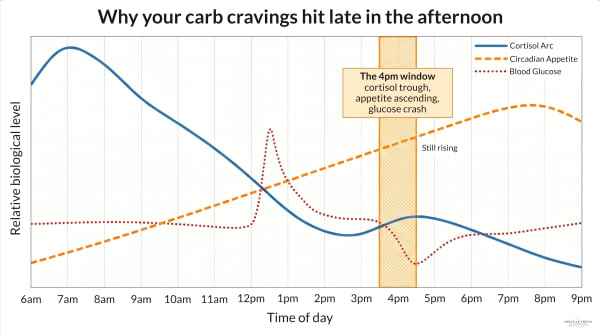
That’s why it’s 4pm. Not the circadian peak, but the worst possible moment for the metabolic crash to arrive.
What Your Brain Is Actually Doing at That Moment
This is where the science becomes genuinely striking, because what happens in the brain four hours after a high-glycaemic meal isn’t just hunger. It’s measurably different from normal appetite.
In a randomised, blinded, crossover trial, Lennerz et al. (2013) had 12 overweight and obese men consume two test meals on separate occasions. [2] Both meals were identical in calories, macronutrient composition, ingredient sources, and, critically, palatability, confirmed by taste ratings that showed no significant difference between the two (5.5 vs 5.3 cm on a visual analogue scale; p = 0.7). The only difference was the glycaemic index. The high-GI meal had a calculated GI of 84; the low-GI meal, 37. (Neuroimaging data were available from 11 of the 12 participants; one participant’s fMRI data were lost due to a data-storage error. Blood glucose, insulin, and hunger data were analysed from all 12.)
At four hours, the researchers measured two things: blood glucose levels and brain activity via functional MRI.
In the 11 participants with usable neuroimaging data, the results were precise. Blood glucose was significantly lower after the high-GI meal (4.7 ± 0.14 vs 5.3 ± 0.16 mmol/L; p = 0.005). Hunger ratings were significantly higher (p = 0.04). And brain activity was significantly greater in a specific, prespecified region: the right nucleus accumbens, with an 8.2% relative difference in cerebral blood flow (p = 0.0006, Bonferroni corrected), spreading to the broader striatum and olfactory areas.
The nucleus accumbens is the brain’s primary craving and reward centre. It’s the same region that becomes activated in substance use disorders. And critically, its activation in this study was related to glucose and insulin levels, not to how the food tasted. Palatability was not significantly associated with nucleus accumbens activity (p = 0.56). The food was the same. The brain response was not.
What this means in practice is important. The craving you feel at 4pm is not about the biscuits in the kitchen being irresistible. It may be about what happened in your bloodstream three hours ago, as your lunch was digested. The drive is metabolic, not sensory.
This is the argument that Professor David Ludwig of Harvard Medical School makes explicitly in a 2026 perspective paper in PLOS Medicine: that the concept of “hyperpalatability” as the mechanism linking ultra-processed foods to addictive eating is circular reasoning. Hyper-palatable foods are defined as foods that drive overconsumption, but saying they drive overconsumption because they’re hyperpalatable explains nothing. The more precise explanation, grounded in the Lennerz data and others, is post-ingestive and metabolic: processed carbohydrates disrupt the food matrix that would normally slow digestion, accelerating glucose absorption, producing a sharper insulin spike, and setting up the four-hour crash that activates reward circuitry. [3]
Many of the foods most commonly associated with binge eating, such as biscuits, crackers, crisps, and white bread, are relatively bland. The drive to eat them compulsively is not about their taste. It’s about their glycaemic fingerprint hours earlier.
Why You Can’t Simply Burn Fat Instead
Here’s the question the earlier section raises: if blood glucose is low four hours after lunch, why doesn’t the body simply switch to burning its vast stores of fat? Why the sudden emergency signal?
The answer lies in an elegant cellular “fuel-switching” system discovered in 1963 by Sir Philip Randle and now known as the Randle Cycle. In a metabolically flexible person, the body smoothly shifts from glucose to fat burning between meals. But when a high-GI lunch triggers a sharp insulin spike, the switch gets temporarily jammed.
Insulin tells the cell to make a molecule called malonyl-CoA, which locks the gate that lets fatty acids enter the mitochondria for burning (the gate is called CPT-1). While that gate stays closed, the cell is caught between fuels: glucose is low, yet fat can’t be accessed. The result is the exact 4 pm crisis you feel. For the full cellular details and how this pattern affects skin ageing through chronic insulin signalling, see our Free Fatty Acids and Lipid Synthesis knowledgebase pages.
This jammed switch is especially common with the moderate-fat + high-refined-carbohydrate combination found in ultra-processed foods; the very profile that creates the metabolic impasse Hue & Taegtmeyer described in their 2009 review. [4]
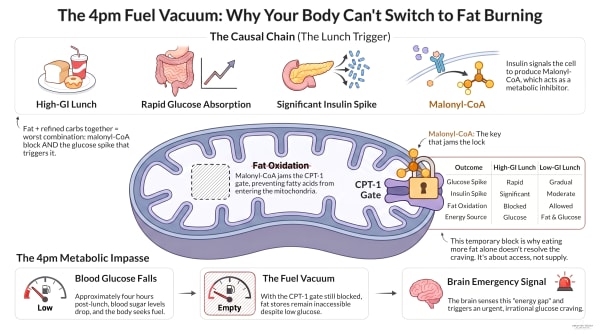
A bag of crisps is the perfect example. Fat and processed carbohydrate, together, are precisely engineered into the profile that blocks fat oxidation while delivering the glucose spike that sets up the four-hour crash.
The Hungry Brain
The cellular energy crisis extends to the brain’s own hunger-control centres, and this is where the picture becomes particularly important for understanding why the 4pm craving can feel genuinely unmanageable rather than merely uncomfortable.
The hypothalamus contains two primary populations of glucose-sensing neurons. POMC neurons are satiety neurons: when glucose levels are adequate, they activate and suppress appetite. NPY/ AgRP neurons are the counterpart: when glucose falls, they activate and drive food seeking, raising hunger to restore blood glucose levels. [5]
Under normal circumstances, this system operates precisely. Blood glucose falls, hunger rises, the individual eats, glucose is restored, satiety is signalled. Clean, efficient, appropriately calibrated.
But in high-fat, high-sugar dietary conditions, hypothalamic glucose sensing becomes impaired. Diet-induced obesity has been shown to reduce GLUT2 expression in the hypothalamus and cause inappropriate AMPK activation, disrupting the sensitivity of these glucose-sensing neurons. [5] POMC neuron glucose responsiveness is impaired in rodent models of high-fat-diet-induced obesity, where mitochondrial dysfunction (particularly in surrounding microglia) disrupts normal glucose sensing. [5] The precision of the system degrades.
Dr Ben Bikman, a professor of cell biology and physiology, describes this state using a striking image from Coleridge’s Rime of the Ancient Mariner: “Water, water, everywhere, nor any drop to drink.” The insulin-resistant brain is like the Ancient Mariner surrounded by undrinkable salt water. [7] Blood glucose may be present in the circulation. Fat stores may contain months of energy. And yet the brain’s hunger centres are signalling deprivation, because they cannot access either fuel effectively. The glucose-sensing neurons are impaired, the fat oxidation pathway is blocked at CPT-1, and ketone production is suppressed by chronically elevated insulin, preventing hepatic fat oxidation.
The sailor has no fresh water, and the ship’s water ration is locked away.
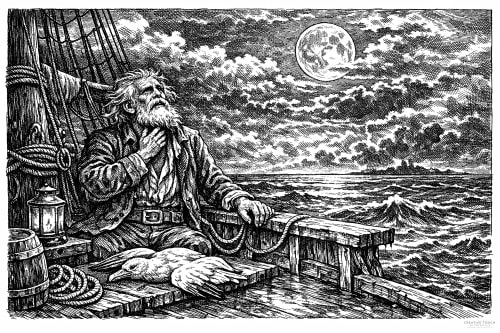
This is the precise cellular scenario that Ludwig (2026) describes as the “central conundrum” of obesity: why people on calorie-restricted diets experience what physiologically resembles starvation, despite carrying months of stored energy. [3] The problem is not the energy. It is the access.
The Two Lunches
The difference between a lunch that sets up the 4pm crisis and one that doesn’t isn’t always dramatic, and it’s not about eating less. Based on the Lennerz et al. (2013) study design, two meals of identical calories, identical macronutrient ratios, and indistinguishable taste can produce fundamentally different metabolic and neurological consequences four hours later.
| High-GI Lunch | Low-GI Lunch | |
|---|---|---|
| Real-world example | White wrap, white rice, cornflakes, commercial fruit yoghurt | Chicken and roasted vegetables, oats, lentil soup, whole grain bread |
| Food matrix | Disrupted: rapid enzyme access, fast digestion | Intact: slows enzyme access, gradual digestion |
| 0–2 hour glucose | Sharp spike; insulin AUC 75% higher | Gradual rise; controlled insulin response |
| At 4 hours | Blood glucose lower (4.7 vs 5.3 mmol/L); CPT-1 inhibition from earlier insulin spike potentially persisting | Blood glucose stable; fat oxidation accessible; Randle switch functioning |
| Brain at 4 hours | Nucleus accumbens activated (8.2% greater blood flow); hunger significantly elevated | No significant reward-centre activation; hunger unremarkable |
| The feeling | Urgent, irrational pull toward high-GI foods | Mild, manageable appetite if any |
The test meals in the Lennerz study used liquid form and focused on overweight and obese men aged 18–35, which limits direct generalisation to all populations and to solid food (Lennerz et al., 2013). [2] These are genuine limitations worth acknowledging. But the mechanistic logic, corroborated by the metabolic framework (Ludwig, 2026) and the Randle Cycle biochemistry (Hue & Taegtmeyer, 2009), holds: it is the rate of carbohydrate digestion, shaped by the food matrix, that determines whether the late postprandial period is physiologically calm or neurologically urgent.
This Is Data, Not a Moral Failing
The 4pm craving is diagnostic information. It’s the body reporting on what happened at breakfast and lunch.
If the craving is predictable, arriving reliably at the same time each day, and if it specifically pulls toward high-GI foods rather than general hunger, it’s worth taking seriously as a signal rather than treating it as a test of character. The hypothalamic AgRP neurons don’t fire because someone lacks discipline. They fire because glucose has dropped below a threshold and the fuel-switching alternative has been blocked.
There is something worth knowing about the circadian layer here, too. The repeated glucose crash and snacking cycle driven by high-GI ultra-processed foods doesn’t just cause problems in isolation, it distributes eating events across the full day in a way that flattens the normal high-amplitude rhythm of appetite. [1] That rhythm should be lowest in the morning and appropriately elevated in the afternoon; when constant grazing disrupts it, the appetite regulation system becomes less responsive to its own timing signals. Chronically disrupted circadian eating patterns are associated with increased risk of obesity, type 2 diabetes, and cardiovascular disease. [1]
The 4pm craving, experienced repeatedly, may therefore be indicating not just a single metabolic event, but a pattern of circadian and metabolic dysregulation that runs across the whole day.
What Actually Helps
This section carries the most important caveat in the article: there is no single intervention that resolves the 4pm craving, because the craving has multiple contributing causes. What the evidence does support is addressing the root causes rather than managing the symptoms.
Reduce the glycaemic load of lunch. This is the most directly evidenced intervention, following from Lennerz et al. (2013) directly. The goal is not to remove carbohydrate but to preserve the food matrix: intact grains, legumes, vegetables, and proteins that slow digestion and blunt the early postprandial glucose and insulin spike. The mechanism is well established. The four-hour brain response depends on the early postprandial glucose and insulin trajectory.
Avoid the fat plus refined carbohydrate combination. Not fat, and not carbohydrate in isolation, but the UPF combination that simultaneously delivers the malonyl-CoA block and the glucose that causes it. This is the metabolically specific harm identified by the Randle Cycle analysis (Hue & Taegtmeyer, 2009). [4]
Consider eating timing. Concentrating caloric intake earlier in the active phase of the day, and avoiding grazing across the full 24 hours, supports circadian resonance and has clinical evidence of metabolic benefit in time-restricted eating research. [1] The evidence that morning-weighted caloric intake specifically reduces afternoon cravings is indirect rather than direct; this is a reasonable mechanistic inference rather than a confirmed finding, and should be understood as such.
Brief movement after lunch. Post-meal walking activates AMPK in skeletal muscle, which phosphorylates and inactivates acetyl-CoA carboxylase, reducing malonyl-CoA and reopening CPT-1. [4] In practical terms, this means fat oxidation becomes accessible sooner after a meal, potentially reducing the duration of CPT-1 inhibition and improving the transition at hour four. The evidence for this, specifically reducing the 4pm craving, is mechanistically supported but not directly tested in human trials to our knowledge. Worth noting, not overstating.
If you’re on GLP-1 medication, or have recently stopped. Tirzepatide and semaglutide suppress appetite through GLP-1 and GIP pathways, which can mask the 4pm craving signal without addressing its metabolic origin. When medication is reduced or stopped, the underlying metabolic inflexibility remains. The dietary framing above, particularly the food matrix and the fat-plus-sugar combination, remains relevant (see our article Life After Mounjaro: Our Practical Guide to Maintaining Weight Loss for a fuller treatment of the post-medication transition). The goal post-medication is to restore the fuel-switching capacity that GLP-1 agonists partially compensate for, not simply to sustain weight through reduced appetite.
The Bigger Picture
The 4pm craving, understood this way, is not a nuisance or a personal weakness. It is the body’s reporting system working as designed, telling you that a cellular-level fuel crisis is occurring, that the fuel-switching mechanism is under stress, and that the metabolic architecture of your eating is placing a recurring load on your brain’s reward circuitry.
The Lennerz data points toward one further implication. Wang et al. (2001) found striatal dopamine D2 receptor availability to be lower in obese individuals than in lean controls, a cross-sectional association that, as Lennerz and colleagues explicitly noted, could not establish causal direction. [6] Whether chronic overconsumption reduces receptor availability or whether pre-existing low availability predisposes to overeating remains unresolved. What the Lennerz data add is a plausible mechanism: each high-GI meal may provide a repeated activation stimulus to the nucleus accumbens, and if recurrent activation contributes to receptor downregulation over time, the link between the daily 4pm craving and longer-term reward-system recalibration becomes neurologically coherent, even if not yet confirmed in prospective human trials. This is the mechanism underlying what the Yale Food Addiction Scale 2.0 measures at the symptomatic level: a pattern of compulsive, craving-driven eating that has neurological as well as behavioural dimensions.
The craving isn’t permanent. Metabolic flexibility, the clean switching between fuel sources that prevents the hour-four crisis, is responsive to dietary change. The respiratory quotient measures fuel-use patterns directly. (A respiratory quotient near 0.7 indicates fat oxidation predominating; near 1.0, glucose (it shifts measurably with dietary modification).) The system is recoverable.
If your 4pm pattern feels less like ordinary hunger and more like a compulsion, including eating past fullness, guilt, or a sense of loss of control, our Yale Food Addiction Scale 2.0 questionnaire offers a validated framework for understanding what might be happening at the behavioural level, alongside the metabolic explanation in this article.
The Ancient Mariner eventually found fresh water; not by chance, and wiser for the voyage, with a clearer eye for the currents that had nearly undone him. So too can our biology, once we understand the hidden tides driving that 4 pm craving.
Frequently Asked Questions
- Is craving carbs at 4pm a sign of diabetes?
Not typically. The mechanism described in this article operates in people with entirely normal blood glucose regulation. The four-hour postprandial crash from a high-GI lunch, combined with the natural cortisol trough, can happen in a metabolically healthy person eating the wrong foods at midday.
A few things distinguish this pattern from diabetes-related glucose issues:
- It’s food-linked and predictable — the 4pm crash follows a high-GI lunch reliably. If switching to lower-GI foods noticeably reduces the craving within a week or two, the mechanism is almost certainly the one described here.
- The glucose drop is relative, not severe — the Lennerz study measured 4.7 mmol/L at four hours, which is below optimal but within the normal clinical range. This is very different from true hypoglycaemia or the unpredictable swings of unmanaged diabetes.
- It responds to dietary change — diabetes-related glucose dysregulation typically persists regardless of meal composition adjustment.
Speak to your GP if cravings persist despite consistent dietary improvement over three to four weeks, or if you are also experiencing unusual thirst, frequent urination, unexplained fatigue, or blurred vision. A fasting blood glucose or HbA1c test is always worth requesting if you have genuine concerns, it provides clear information and peace of mind.
- I’m tired and craving sugar at the same time — are these connected?
They’re two expressions of the same biological event, not two separate problems arriving at once.
Cortisol is both the body’s primary alertness hormone and its main glucose-mobilising hormone. When it reaches its natural afternoon trough, two things happen simultaneously:
- The tiredness — cortisol is no longer supporting mental alertness and focus. This is why many cultures have historically built afternoon rest periods around this window; it’s physiologically normal.
- The craving — cortisol is also withdrawing its support for maintaining blood glucose, which means any postprandial crash from a high-GI lunch lands harder. The brain’s response (nucleus accumbens activation, rising ghrelin, NPY/AgRP neuron firing) is seeking a rapid glucose restore.
Both symptoms share the same root, which is useful to know: addressing lunch quality tends to improve both the energy dip and the craving together. If you find that improving your lunch removes the tiredness but not the craving, or vice versa, that asymmetry is worth noting because it may indicate other contributing factors.
- My cravings aren’t just at 4pm — they happen all day. Does this article still apply?
Yes, and all-day cravings usually indicate that the process described here has progressed further — the circadian appetite rhythm has already been disrupted, not just nudged.
Under normal circumstances, appetite follows a high-amplitude daily arc: lowest in the morning, rising appropriately through the afternoon. This rhythm depends on eating patterns. When high-GI snacking and grazing distribute insulin spikes across the full day, the rhythm flattens, appetite becomes constant rather than appropriately timed, and the body becomes less responsive to its own hunger signals. The article describes this in the “This Is Data, Not a Moral Failing” section.
If this sounds familiar:
- Start with the lunch intervention — even persistent all-day cravings often have a postprandial anchor, and changing the glycaemic load of lunch is the most directly evidenced starting point.
- Allow four to six weeks of consistent dietary change before expecting the rhythm to meaningfully re-establish — circadian recalibration is gradual.
If cravings remain intense despite genuine dietary adjustment over that period, or if they’re accompanied by significant fatigue, mood changes, or weight changes that don’t make sense given your eating, speak to your GP. Thyroid function, insulin resistance, and cortisol dysregulation can all produce similar patterns and are straightforward to assess.
- Why are my carb cravings worse in the week before my period?
They almost certainly are worse and there’s a clear biological reason that compounds the 4pm mechanism described in this article.
In the luteal phase (the week or so before your period), two hormonal shifts intensify carbohydrate cravings:
- Progesterone rises, which slightly increases basal metabolic rate and overall appetite. The 4pm mechanism is still operating; it’s simply landing against an already elevated baseline.
- Oestrogen begins to fall, and oestrogen supports serotonin production. Lower serotonin is associated with stronger carbohydrate cravings — particularly for rapidly digested carbohydrates — because consuming them helps tryptophan cross the blood-brain barrier and provides a transient serotonin lift. This is a distinct drive from the blood glucose mechanism, running in parallel.
Many people find that lower-GI eating is particularly valuable in the premenstrual week, not to suppress a physiological drive, but to avoid adding a blood glucose crash to a system that’s already under hormonal pressure. This is normal biology, not a sign that something is wrong.
- I’m taking Mounjaro or semaglutide — does this approach still apply to me?
Yes, and it may matter more than usual, particularly if you’re thinking ahead to life after medication.
GLP-1 and GIP receptor agonists suppress appetite through hormonal signalling pathways that can mask the 4pm craving without resolving its metabolic root. The Randle Cycle block, the postprandial glucose dynamics, and the circadian pattern described in this article continue operating beneath the medication’s effect.
Two things follow from this:
- Whilst on medication — the food-matrix principles (lower-GI lunches, avoiding fat combined with refined carbohydrate) still support insulin sensitivity and longer-term metabolic flexibility. The medication is suppressing the signal; it isn’t doing the underlying metabolic work.
- When tapering or stopping — the 4pm pattern tends to re-emerge, sometimes more clearly than before. Building dietary habits whilst appetite suppression is supporting you is valuable preparation, not unnecessary effort.
Our article Life After Mounjaro: Our Practical Guide to Maintaining Weight Loss covers the fuel-switching restoration and post-medication dietary transition in more detail.
- What should I eat or do if the 4pm craving hits anyway?
Work with the signal rather than against it. The craving is reporting a metabolic state; trying to override it through willpower alone is rarely effective and isn’t necessary.
If you decide to eat:
- Protein and fat (a small handful of nuts, a piece of cheese, a hard-boiled egg) — these don’t trigger a meaningful insulin spike and won’t extend the Randle Cycle block
- Low-GI carbohydrate (oatcakes, a small apple) — if you want carbohydrate, choose something with an intact food matrix that slows digestion
- Avoid fat combined with refined carbohydrate (biscuits, crisps, cereal bars) — this is the precise combination that perpetuates the pattern described in this article
If you’d rather not eat:
- A 10–15 minute walk activates AMPK in skeletal muscle, reducing malonyl-CoA and reopening the CPT-1 gate, making fat oxidation available sooner — the mechanism described in the “What Actually Helps” section
- Drink water first — mild dehydration compounds the hunger signal and is worth ruling out
If the craving consistently feels compulsive rather than ordinary hunger, particularly if it’s difficult to stop once you’ve started eating, our Yale Food Addiction Scale 2.0 questionnaire offers a validated framework for understanding what’s happening at the behavioural level.
- Should I just cut out carbohydrates completely to fix the cravings?
No, and this is a distinction the article makes throughout. The problem is the rate at which carbohydrates are digested, not carbohydrates as a macronutrient.
The food matrix, the physical structure of intact grains, legumes, and vegetables, slows enzyme access to the carbohydrate inside and produces a gradual, controlled glucose and insulin response. That slow digestion is what prevents the four-hour blood glucose crash and the CPT-1 block. Complete carbohydrate elimination removes the dietary flexibility that makes any approach sustainable long-term, and isn’t supported by the evidence here as the necessary intervention.
A lunch of chicken with roasted vegetables, lentils, and a slice of whole grain bread contains substantial carbohydrate. It simply doesn’t create the same postprandial trajectory as a white wrap or bowl of cornflakes, because the food matrix is intact and digestion is gradual.
The goal is to eat carbohydrate in a form that your digestive system has to work for, not to avoid it altogether.
- If I change my lunch, how quickly will the 4pm cravings improve?
Some improvement may come faster than you’d expect; full recovery of metabolic flexibility takes longer.
- Within days — if you eat a genuinely lower-GI lunch, the four-hour blood glucose trajectory should be different almost immediately. The Lennerz study measured a significant difference in blood glucose levels and hunger ratings after a single meal. Many people notice the 4pm craving is less intense or more manageable within just a few days of consistent change.
- Within two to six weeks — metabolic flexibility — the clean fuel-switching between glucose and fat described in the Randle Cycle section — improves gradually with consistent dietary change. The CPT-1 mechanism becomes less chronically inhibited. Meaningful improvement in the underlying pattern typically develops over this window.
- Longer term — if the circadian appetite rhythm has been disrupted by long-term grazing and snacking patterns, re-establishing a clearer daily rhythm takes more time. It is, as the article describes, responsive to change — but rhythmic recalibration is gradual.
Individual variation is real here. Some people notice a rapid shift within the first week; for others, the pattern settles more slowly. Be patient with the process and consistent with the approach rather than measuring progress day to day.
References
McHill, A., Butler, M. (2024). Eating Around the Clock: Circadian Rhythms of Eating and Metabolism. Annual Review of Nutrition, 44(1), 25-50. doi.org/10.1146/annurev-nutr-062122-014528
doi: 10.1146/annurev-nutr-062122-014528Lennerz, B., Alsop, D., Holsen, L., Stern, E., Rojas, R., Ebbeling, C., Goldstein, J., Ludwig, D. (2013). Effects of dietary glycemic index on brain regions related to reward and craving in men. The American Journal of Clinical Nutrition, 98(3), 641-647. doi.org/10.3945/ajcn.113.064113
doi: 10.3945/ajcn.113.064113Ludwig, D. (2026). Are ultra-processed foods too tasty? Toward a metabolic framework for diet and obesity. PLOS Medicine, 23(4), e1005025. doi.org/10.1371/journal.pmed.1005025
doi: 10.1371/journal.pmed.1005025Hue, L., Taegtmeyer, H. (2009). The Randle cycle revisited: a new head for an old hat. American Journal of Physiology-Endocrinology and Metabolism, 297(3), E578-E591. doi.org/10.1152/ajpendo.00093.2009
doi: 10.1152/ajpendo.00093.2009Yoon, N., Diano, S. (2021). Hypothalamic glucose-sensing mechanisms. Diabetologia, 64(5), 985-993. doi.org/10.1007/s00125-021-05395-6
doi: 10.1007/s00125-021-05395-6Wang, G., Volkow, N., Logan, J., Pappas, N., Wong, C., Zhu, W., Netusll, N., Fowler, J. (2001). Brain dopamine and obesity. The Lancet, 357(9253), 354-357. doi.org/10.1016/S0140-6736(00)03643-6
doi: 10.1016/S0140-6736(00)03643-6Bikman, B. (2024). The Randle Cycle - How Your Body Chooses Between Glucose and Fat with Dr. Ben Bikman [Video]. YouTube. Ben Bikman. youtube.com/watch?v=OlsjnLMANDQ
videoId: OlsjnLMANDQ