
Food addiction
Food addiction describes a pattern of compulsive, loss-of-control eating behavior directed predominantly at hyperpalatable ultra-processed foods, driven by the same mesolimbic dopamine reward circuitry that underlies substance use disorders. It is not a formal DSM-5 diagnosis, but the neurobiological evidence for addiction-like processes in response to engineered foods – including dopamine receptor downregulation, ΔFosB accumulation, and μ-opioid receptor activation – is substantial and mechanistically distinct from simple overeating or homeostatic hunger. The Yale Food Addiction Scale 2.0 (YFAS 2.0) provides the primary validated measurement tool, applying DSM-5 substance use disorder criteria to eating behavior. Creative Touch’s own experiential dataset of over 4,800 completions indicates that 47.3% meet the threshold for clinical significance, with an average symptom count of 4.7 out of 11. The central clinical complexity lies in the restriction response – the biological hunger escalation produced by caloric deprivation – which generates symptoms that are neurobiologically indistinguishable from food addiction on the YFAS 2.0. Thus, making the distinction between the two becomes the most important decision point in any intervention.
The question of whether food can be addictive in the same neurobiological sense as drugs and alcohol has generated significant scientific debate. The answer that has emerged from two decades of neuroimaging, animal model, and clinical research is nuanced but increasingly clear: highly engineered ultra-processed foods activate the same reward circuits, through some of the same molecular mechanisms, as addictive substances – and in susceptible individuals, produce the same progressive loss of control, tolerance, and compulsive use. The debate is no longer primarily about whether these mechanisms exist, but about how to classify them clinically and how to distinguish them from the overlapping phenomenon of restriction response in individual patients.
What Food Addiction Is – and Is Not
Food addiction is not a formal DSM-5 diagnosis. It is a construct – a framework for understanding why some individuals experience loss of control, craving, continued use despite consequences, and failed attempts to quit in relation to specific foods, using the same conceptual lens applied to substance use disorders. The YFAS 2.0, the primary validated measurement instrument, operationalises this construct by mapping eating behaviour onto DSM-5 substance use disorder criteria; a score of two or more symptoms with clinical significance is the threshold for classification. The YFAS 2.0 is covered in detail in the associated YFAS 2.0 article; this entity focuses on the underlying neurobiology and clinical complexity that the measurement tool describes rather than the tool itself.
Food addiction exists on a spectrum and overlaps meaningfully with binge eating disorder, emotional eating, and disordered eating more broadly. The overlap is not coincidental – these conditions share neurobiological substrates. What distinguishes food addiction as a construct is its specificity to the reward-activating properties of particular foods, particularly the fat-sugar-salt combinations and engineered textures of ultra-processed foods, rather than emotional or contextual triggers alone. [4]
The Mesolimbic Reward System: How UPFs Hijack It
The brain’s reward system – the mesolimbic dopamine pathway – evolved to reinforce behaviours critical to survival: eating, reproduction, social bonding. Its core architecture runs from the ventral tegmental area (VTA) to the nucleus accumbens (NAc), with projections to the prefrontal cortex (PFC) that regulate impulse control and decision-making. When a rewarding stimulus is encountered, dopamine neurons in the VTA fire, releasing dopamine in the NAc, which generates the subjective experience of wanting and motivates repeated behaviour. This is not the pleasure of eating – it is the drive to seek it. The distinction matters: dopamine encodes wanting, not liking; the opioid system encodes liking. Both are engaged by hyperpalatable foods, and their interaction is what makes engineered UPFs particularly difficult to moderate.
Ultra-processed foods are specifically formulated to maximise the speed and magnitude of this reward signal. Rapid nutrient release – pregelatinised carbohydrates, emulsified fats, engineered melt-in-mouth textures – floods the mesolimbic pathway with reward signal faster than any whole food can. The pharmacokinetics parallel those of addictive substances: rapid absorption producing a sharp reward peak is more reinforcing than slow, sustained absorption of equivalent total reward. [6]
ΔFosB: The Molecular Switch of Reward Sensitisation
Repeated activation of the reward system by the same stimulus does not simply maintain the same response – it changes the brain. The key molecular mechanism is the accumulation of ΔFosB (delta FosB), a transcription factor in the nucleus accumbens that builds up with repeated reward exposure and, because it is highly stable relative to other Fos family proteins, persists long after the stimulus is removed. [5]
ΔFosB functions as a molecular switch: its accumulation progressively alters gene expression in reward circuits in ways that increase sensitivity to reward-associated cues whilst reducing the satisfaction derived from the reward itself. In practical terms, this means the same food becomes more wanted but less satisfying – the neurobiological basis of tolerance and escalation. This mechanism was first characterised in drug addiction, but animal models of binge eating on high-palatable food demonstrate equivalent ΔFosB accumulation in the NAc, confirming that the same molecular process operates in response to engineered foods. The implication is significant: in susceptible individuals with sufficient exposure, the reward system undergoes lasting structural change that persists beyond any single eating episode – which is why food addiction, like substance addiction, cannot be resolved simply by removing access to the food. [5]
DRD2 Downregulation: The Tolerance Mechanism
Chronic dopamine release from repeated UPF consumption produces a compensatory response at the receptor level: downregulation of dopamine D2 receptors (DRD2) in the striatum. This is the tolerance mechanism – as receptor density falls, more stimulation is required to achieve the same reward signal, driving escalating consumption. [1]
Neuroimaging studies in obese humans have directly confirmed this: striatal DRD2 availability is reduced in obese individuals at levels comparable to those seen in cocaine and heroin-dependent patients. The same DRD2 reduction is associated with decreased metabolism in prefrontal regions governing inhibitory control – meaning that as reward-seeking escalates, the brain’s capacity to override it simultaneously declines. This bidirectional impairment – more wanting, less control – is the neurobiological architecture of compulsive eating, and it is why telling someone with food addiction to simply exercise more self-discipline is not only unhelpful but mechanistically incoherent. [6]
The DRD2 deficit also helps explain the strong co-occurrence between food addiction and other addictive disorders. Reduced striatal DRD2 is a trait marker in addiction-prone individuals – present before substance exposure in some cases, and conferring vulnerability across reward modalities. Food addiction, alcohol use disorder, and substance use disorder share this underlying dopaminergic deficit, which is why they cluster together clinically and why addressing one addiction without addressing the underlying reward system dysregulation frequently produces substitution rather than resolution.
The μ-Opioid Component: Why Hyperpalatable Foods Feel Good
Whilst dopamine drives wanting, the subjective pleasure of eating – the hedonic liking component – is mediated primarily by μ-opioid receptors (MORs), particularly in the nucleus accumbens and medial prefrontal cortex. Hyperpalatable foods – specifically fat-sugar combinations, sweet tastes, and creamy textures – activate MOR signalling directly. [3]
This opioid activation is the mechanism behind the immediate sensory pleasure of UPFs that makes them effective reinforcers: it is not simply caloric reward but pharmacological-grade sensory reward through an endogenous opioid pathway. The clinical evidence for this comes from naltrexone studies – the opioid receptor antagonist used in alcohol and opioid dependence – which demonstrate selective reduction in the consumption of and motivation to obtain highly palatable food when administered systemically or directly into the mPFC, without equivalent effect on standard food intake. This pharmacological selectivity is direct evidence that opioid receptor activation is a specific mechanism of UPF reinforcement, not a general effect on hunger. jocmr
The opioid component also interacts with the dopamine system: MOR activation in the VTA increases dopamine release in the NAc, amplifying the reward signal from palatable food beyond what either system would produce alone. Fat-sugar combinations are particularly potent because they engage both pathways simultaneously – opioid via palatability and dopamine via rapid energy delivery – which is why these combinations appear consistently at the top of YFAS-associated food lists and why they are the deliberate compositional target of UPF engineering. [3]
Homeostatic vs Hedonic Eating: Two Separate Circuits
A critical distinction for both understanding and treating food addiction is the separation between homeostatic hunger – energy-deficit driven eating regulated by the arcuate nucleus, ghrelin, leptin, and GLP-1 – and hedonic eating, driven by the mesolimbic reward system independently of energy status.
These two circuits operate in parallel and can drive eating simultaneously, but they are anatomically and mechanistically distinct. Homeostatic hunger responds to energy deficit and is satisfied by adequate caloric intake regardless of food type. Hedonic eating responds to reward cue exposure and palatability, and is not reliably satisfied by caloric repletion – which is why someone can finish a full meal and still experience intense desire for a specific UPF. The reward circuit is not asking whether energy is needed; it is responding to a conditioned cue. [4]
This distinction has a direct clinical implication: dietary strategies that address homeostatic hunger – adequate protein and fat activating the ileal brake, GLP-1 and PYY suppressing appetite, leptin signalling energy sufficiency – do not directly address hedonic eating driven by mesolimbic dopamine. They reduce the homeostatic hunger component, which is valuable and often sufficient for individuals whose YFAS score reflects restriction response rather than true reward system dysregulation. But for individuals with genuine mesolimbic adaptation – ΔFosB accumulation, DRD2 downregulation, opioid sensitisation – dietary composition alone does not resolve the compulsive eating drive, and expecting it to do so sets both client and practitioner up for failure.
Ghrelin bridges these two systems. Beyond its homeostatic role in appetite stimulation via arcuate NPY/ AgRP neurons, ghrelin activates GHS-R1a receptors in the VTA and NAc – directly amplifying mesolimbic dopamine signalling and increasing the motivational salience and reward value of food. This is the mechanism established in the Ghrelin entity: elevated ghrelin doesn’t simply make you hungry, it makes food more rewarding. During caloric restriction, ghrelin rises – which means restriction simultaneously drives homeostatic hunger and amplifies hedonic food reward, compounding both dimensions of eating drive at once. [2]
Stress, Cortisol, and Inhibitory Control
Chronic stress degrades the capacity to resist hedonic eating through two converging mechanisms. First, cortisol directly upregulates NPY/AgRP signalling in the arcuate nucleus, increasing homeostatic hunger – the same pathway ghrelin activates, with an additive effect under combined restriction and stress. Second, and more specifically relevant to food addiction, chronic cortisol elevation degrades prefrontal cortical function – reducing the inhibitory control capacity that would normally override reward-driven food-seeking impulses from the mesolimbic system. [6]
The prefrontal cortex (PFC) – particularly the orbitofrontal and dorsolateral prefrontal regions – normally exerts top-down inhibition on NAc-driven reward responses. In states of chronic stress, prefrontal metabolism and grey matter density both decline, reducing this inhibitory capacity. This is the biological mechanism behind the clinical observation that stressed individuals have lower impulse control around food: it is not a character deficiency but a measurable reduction in prefrontal inhibitory tone. Combined with the DRD2 downregulation that reduces prefrontal metabolism specifically in obesity, the result is a progressive narrowing of the neural gap between reward impulse and eating behaviour. [6]
The Restriction Response: Same Symptoms, Different Mechanism
The most clinically important complexity in food addiction assessment is the restriction response – the biological eating-drive escalation produced by caloric deprivation – which generates symptoms that are neurobiologically indistinguishable from food addiction on the YFAS 2.0. Caloric restriction elevates ghrelin, suppresses leptin, and activates mesolimbic dopamine sensitisation through food cue reactivity, producing intense cravings, loss of control on food access, and preoccupation with food that maps directly onto YFAS 2.0 criteria.
The mechanistic reason for this overlap is established in the Ghrelin entity: elevated ghrelin directly amplifies VTA dopamine signalling, meaning that the restriction-induced ghrelin rise produces genuine reward system activation – not merely hunger – in response to food cues. Restriction and addiction converge on the same neural architecture through different entry points.
The distinction matters because the interventions diverge sharply. Restriction response resolves with adequate nutrition – specifically, adequate protein and fat activating genuine satiety through the ileal brake, removing the caloric deficit that is driving the ghrelin elevation. True food addiction, with established mesolimbic adaptation, requires addressing the reward system itself – through behavioural approaches, potentially pharmacological support, and strategies that reduce UPF cue exposure rather than simply improving dietary quality. The clinical and practical navigation of this distinction is developed fully in the Food Addiction vs Restriction Response article.
Co-occurrence and Clinical Triage
Food addiction clusters with other conditions that share its underlying neurobiological substrate – reduced striatal DRD2, prefrontal hypometabolism, impaired inhibitory control – at rates significantly above chance. The most clinically relevant co-occurrences are:
- Substance use disorder – shared dopaminergic deficit; addiction substitution risk if food addiction is addressed in isolation
- ADHD – DRD2 and prefrontal dopamine deficits are central to ADHD neurobiologically; impulsivity is both a symptom of ADHD and a driver of loss-of-control eating
- Depression and anxiety – stress-driven cortisol elevation degrades prefrontal inhibitory control; emotional eating and food addiction frequently co-occur with mood disorders as a shared consequence of reward system dysregulation
- Binge eating disorder – the most directly overlapping clinical construct; many BED presentations meet YFAS 2.0 criteria, though BED has the advantage of formal DSM-5 recognition enabling treatment pathways
For clinical triage at Creative Touch, the practical implication is that a YFAS 2.0 severe score in a client with known ADHD, a history of substance use, or significant depression is a different clinical picture from a YFAS 2.0 severe score in a client whose dieting history clearly precedes their current eating pattern. The former warrants referral to a specialist; the latter may respond well to the nutrition-first satiety approach. Conflating the two does a disservice to both groups.
Skin and Aesthetics Context
The connection between food addiction and skin is not direct but is clinically real through two pathways. First, the dietary pattern characteristic of food addiction – high in rapidly absorbed refined carbohydrates and UPFs – drives glycation, AGE accumulation in collagen and elastin, and persistent NF-κB-mediated systemic inflammation – the inflammageing mechanism – that accelerates biological ageing across tissues, degrades dermal matrix quality, and impairs treatment responsiveness. AGEs activate RAGE, which is itself an NF-κB activator, creating a self-amplifying loop between glycation and inflammation that feeds directly into the cellular senescence and hallmarks of ageing cascades. A client whose skin is not responding to treatment as expected is sometimes a client whose diet is continuously degrading the collagen the treatment is building.
Second, the chronic stress that both drives and results from food addiction – elevated cortisol, HPA axis dysregulation – suppresses fibroblast collagen synthesis, accelerates MMP-mediated collagen degradation, impairs skin barrier function, and reduces epidermal turnover. The skin presentation of chronic stress is well established; what is less often recognised in an aesthetics context is that the stress may be partly driven by the shame, social impairment, and loss of control that the YFAS 2.0 measures as clinical significance criteria.
A third pathway connects food addiction to skin through metabolic chronodisruption. The fat-sugar combination characteristic of the hyperpalatable UPFs that the mesolimbic reward circuit specifically targets – and that the DRD2 downregulation and FosB accumulation mechanism drives escalating consumption of – is precisely the simultaneous macronutrient delivery that the Randle Cycle identifies as creating the metabolic impasse. The metabolic impasse generates NADH accumulation, reducing the NAD⁺/NADH ratio and depleting the cellular NAD⁺ pool that SIRT1 requires to sustain circadian clock amplitude in skin cells. Where the glycation and cortisol pathways described above operate continuously, the metabolic chronodisruption pathway is compounded by chronicity: it is the repeated and compulsive nature of UPF consumption – the behavioural architecture the food addiction entity describes – that sustains the metabolic impasse long enough for its circadian consequences to become structural. A client whose eating is controlled by mesolimbic reward dysfunction rather than homeostatic hunger is not occasionally creating the conditions for metabolic chronodisruption; they may be creating them daily. The mechanism is developed in full in the Metabolic Chronodisruption page.
For clients whose food addiction presentation includes consistently late or evening-weighted eating – a pattern common in loss-of-control eating presentations where hedonic drive intensifies when homeostatic inhibitory signals weaken through the day – there is a second, independent disruption to skin repair. Feeding timing is an entrainment signal for the skin peripheral clock, and consistently late eating phase-shifts the skin clock independently of what is eaten or how much. When this is a chronic pattern rather than an occasional occurrence, the skin’s repair window alignment with sleep is progressively displaced. Both disruptions – metabolic amplitude reduction from the fat-sugar impasse and phase displacement from late feeding timing – can be active simultaneously in the same client.
References
Benton D, Young HA (2016). A meta-analysis of the relationship between brain dopamine receptors and obesity: a matter of changes in behavior rather than food addiction? Int J Obes (Lond), 40 Suppl 1(Suppl 1), S12-21 . doi.org/10.1038/ijo.2016.9
Davis JF, Perello M, Choi DL, et al. (2012). GOAT induced ghrelin acylation regulates hedonic feeding. Horm Behav, 62(5), 598-604 . doi.org/10.1016/j.yhbeh.2012.08.009
Giuliano C, Cottone P (2015). The role of the opioid system in binge eating disorder. CNS Spectr, 20(6), 537-45 . doi.org/10.1017/s1092852915000668
Johnson PM, Kenny PJ (2010). Dopamine D2 receptors in addiction-like reward dysfunction and compulsive eating in obese rats. Nat Neurosci, 13(5), 635-41 . doi.org/10.1038/nn.2519
Nestler EJ, Barrot M, Self DW (2001). DeltaFosB: a sustained molecular switch for addiction. Proc Natl Acad Sci U S A, 98(20), 11042-6 . doi.org/10.1073/pnas.191352698
Wang GJ, Volkow ND, Thanos PK, et al. (2009). Imaging of brain dopamine pathways: implications for understanding obesity. J Addict Med, 3(1), 8-18 . doi.org/10.1097/adm.0b013e31819a86f7
Also Known As
- compulsive overeating
- eating addiction
Learn More
This topic is discussed in 5 articles:
-

Why Is Food Constantly on My Mind?
Primary TopicA compulsive pattern of eating characterised by symptoms similar to substance addiction, including tolerance, withdrawal, and loss of control. Assessed using the Yale Food Addiction Scale (YFAS)
-

Discover how the Yale Food Addiction Scale 2.0 identifies addictive eating behaviours and what your results mean. Learn about symptoms, clinical significance, and how food addiction impacts health.
-
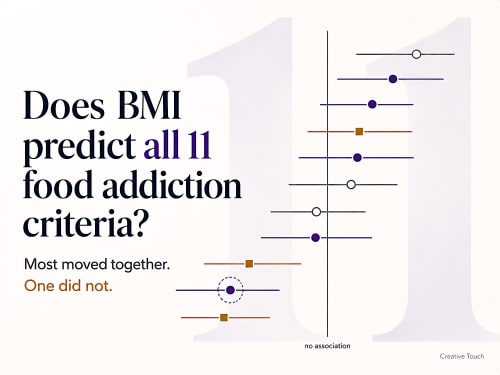
We tested whether BMI links to all 11 parts of our food addiction quiz equally. It doesn’t, and one result ran opposite to our own prediction.
-

You’ve successfully lost weight with Mounjaro, but what happens when you stop taking it? Evidence-based approaches to maintaining weight loss.
-

That sudden 4pm carb craving after a proper lunch isn’t a lack of willpower. It’s three biological systems colliding at exactly the wrong moment. Discover the metabolic science behind it and what actually helps.