
Cryolipolysis
Cryolipolysis (fat freeze) is a popular non-surgical alternative to liposuction. It is a fat reduction treatment that exploits a fundamental difference between adipocytes and surrounding tissue: fat cells begin to crystallise and die at temperatures that leave the overlying dermis, vasculature, and nerves physiologically intact. Controlled cooling applied through paddle applicators triggers a sequence of adipocyte injury and programmed cell death, followed by macrophage-mediated clearance that reduces the treated fat layer over 8–12 weeks. The process is gradual, the results are real and measurable, and the mechanism is well-understood at the cellular level – but cryolipolysis is a body contouring treatment, not a weight-loss intervention, and the distinction matters for setting accurate expectations. A rare but important adverse event – paradoxical adipose hyperplasia – requires explicit pre-treatment disclosure and honest clinical management when it occurs.
While the biological process of cryolipolysis is complex, the clinical application is straightforward: it is designed to contour the body by reducing localised “pockets” of fat that are often resistant to traditional diet and exercise.
Because the treatment is non-invasive, it can be precisely applied to several key areas of the body. Most commonly, cryolipolysis is used to treat fat deposits beneath the chin, upper arms, inner and outer thighs, abdomen, hips/flanks (“love handles”), upper back (“brassiere rolls”), lower back, and underneath the buttocks.
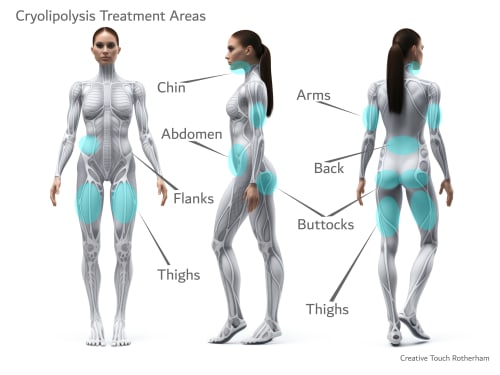
By focusing on these specific zones, we can sculpt a more defined silhouette without the downtime associated with surgical alternatives. To understand how we can freeze fat without damaging the skin or surrounding tissue, we look at the specific way fat cells respond to thermal changes.
Why Adipocytes Are Selectively Vulnerable to Cold
The selective mechanism of cryolipolysis rests on a physical chemistry difference between adipocytes and the cells surrounding them. The cytoplasm of most cells is predominantly aqueous; water requires temperatures well below 0°C to crystallise under physiological conditions. Adipocytes, by contrast, contain a large intracellular lipid droplet – and lipids begin to undergo crystallisation (forming what researchers have termed “lipid ice”) at temperatures between approximately −1°C and +5°C. At these temperatures, adipocyte structural integrity begins to fail whilst the more aqueous neighbouring cells – dermal fibroblasts, keratinocytes, endothelial cells, nerve sheaths – remain largely unaffected. [5]
This differential vulnerability is the entire basis of cryolipolysis as a selective treatment. The cooling target is not low enough to damage tissue indiscriminately; it is calibrated to the specific temperature range at which lipid crystallisation initiates adipocyte injury without producing the broader tissue damage that lower temperatures would cause.
Three Mechanisms of Cold-Induced Adipocyte Injury
Current evidence supports three overlapping mechanisms through which controlled cooling injures adipocytes, all converging on apoptosis – programmed cell death – rather than necrosis. [5]
Intracellular lipid crystallisation is the primary and most characterised mechanism. Lipid crystal formation within the adipocyte creates direct mechanical stress on the cell membrane and organelles, disrupting cellular integrity. This process was first demonstrated in vivo in porcine models [6] and has since been confirmed histologically in post-treatment human tissue biopsies showing the characteristic pattern of cellular injury and subsequent macrophage infiltration. [1]
Cold ischaemic injury occurs as reduced temperature suppresses Na⁺/K⁺-ATPase activity – the ion pump maintaining cellular electrochemical balance. This disruption causes cellular oedema and intracellular acidosis, compounded by the vasoconstriction induced by cold exposure that reduces local blood flow and allows metabolic waste accumulation. The vacuum mechanism used in paddle applicators further reduces local blood flow during treatment, contributing to this pathway. [5]
Reperfusion injury occurs when normal blood flow is restored after the cooling period, reintroducing oxygen into temporarily ischaemic tissue and generating reactive oxygen species from ATP degradation products. This oxidative burst causes additional adipocyte membrane damage that compounds the cold ischaemic injury.
All three pathways activate apoptotic cascades rather than necrotic cell rupture – a distinction with direct clinical significance.

Apoptosis Versus Necrosis – Why It Matters Clinically
The distinction between apoptotic and necrotic adipocyte death is not a minor biochemical technicality; it determines the clinical course after treatment.
Necrosis is uncontrolled cell death characterised by rapid membrane rupture and abrupt release of intracellular contents – including triglycerides, DAG, and pro-inflammatory cell fragments – into surrounding tissue. This triggers an immediate, intense acute inflammatory response with significant tissue damage potential.
Apoptosis is a controlled, programmed death sequence in which the dying cell packages its contents into membrane-bound vesicles that macrophages recognise and phagocytose in an orderly process. The inflammatory response is localised, graduated, and self-resolving. Crucially, the triglycerides released from apoptotic adipocytes are processed through normal macrophage lipid metabolism and lymphatic clearance pathways rather than flooding systemic circulation – which is why blood lipid levels (total cholesterol, LDL, HDL, triglycerides) are consistently unchanged or mildly improved following cryolipolysis, not elevated. [3]
The apoptosis pathway is also what makes the result timeline what it is. Cell death is not immediate; the full apoptotic sequence, macrophage recruitment, phagocytosis, and lymphatic clearance takes weeks. This is not a treatment limitation – it is the mechanism operating correctly.
The Secondary Mechanism – Beige Adipocyte Conversion
A second, contested mechanism has gained research interest: the possibility that cold stimulus activates beige adipocyte conversion within the treated white adipose tissue – upregulating UCP-1 expression and driving thermogenic fat oxidation as a contributing pathway to the overall fat reduction. [8]
A 2025 pilot study found elevated PPARγ, PPARα, and UCP-1 markers in adipose tissue following cryolipolysis, consistent with white-to-beige adipocyte conversion. This is biologically plausible – cold exposure is a well-established activator of beige adipocyte thermogenesis – but the evidence for its contribution in clinical cryolipolysis specifically remains pilot-level. The relative contribution of this pathway versus the apoptosis-clearance mechanism cannot currently be separated in the available human data. It is a mechanistically credible hypothesis, not an established primary pathway. [8]
Clinical Evidence
The evidence base for cryolipolysis as a fat-reduction modality is consistent across multiple study designs, though the absolute effect sizes are modest and vary considerably between individuals. [2]
Fat layer reduction: Caliper and ultrasound measurements across systematic reviews report 14–28% fat layer reduction per treatment cycle in the treated area. This refers to the local fat layer thickness, not overall body fat percentage – an important distinction for expectation management. [3]
Body composition: A 2024 clinical study using plate/paddle applicators across three sessions found statistically significant reductions in absolute fat mass (mean 4.1 kg, from 26.9 to 25.8 kg) and BMI (mean 0.7 points), with individual responses ranging from 1.4% to 28% fat mass reduction – indicating substantial inter-individual variation. [5]
Lipid safety: Total cholesterol and LDL showed modest but statistically significant reductions post-treatment; HDL and triglycerides were unchanged. This addresses a common client concern – that fat cell destruction releases lipids into circulation – the evidence consistently shows no adverse lipid effect and no elevation in liver enzymes. [5]
Post-treatment massage: Controlled studies demonstrate that immediate post-treatment massage significantly enhances outcomes – one study showing 44–68% greater fat reduction in massaged versus non-massaged treated areas at two months. The mechanism is mechanical disruption of the crystallised adipocyte mass during the vulnerable post-cooling window, and it is the basis for the manual massage protocol performed at the end of each treatment session. [3]
These results position cryolipolysis accurately: it is an effective body contouring treatment for localised fat deposits, producing consistent and measurable results in well-selected candidates. It is not a treatment for generalised obesity or a substitute for dietary and lifestyle change.
Paradoxical Adipose Hyperplasia
Paradoxical Adipose Hyperplasia (PAH) is the most clinically significant adverse event associated with cryolipolysis and requires explicit pre-treatment disclosure as a clinical and ethical obligation.
What it is: Rather than the expected fat reduction, PAH produces a paradoxical increase in adipose volume in the treated area – typically a firm, well-demarcated enlargement that becomes visible 2–6 months after treatment. The enlargement is visually and palpably distinct from the surrounding tissue and does not resolve spontaneously. [4]
Mechanism: The exact mechanism is not established. Current hypotheses include paradoxical preadipocyte proliferation stimulated by the cold injury, sympathetic nerve disruption altering local adipose regulation, cold-induced hypoxia triggering fibrotic and hyperplastic responses, or fibrous septal thickening creating a compartmental expansion effect. No single mechanism has been confirmed. [7]
Incidence – an evolving picture: The originally reported incidence of approximately 0.0051% (1 in 20,000 treatment cycles) from early post-market data is now considered a significant underestimate, reflecting incomplete adverse event reporting rather than true population incidence. More recent multicenter evaluation data report incidence figures of less than 1 in 2,000, with some case series reporting rates up to 0.41% depending on device generation, applicator type, anatomical site, and patient characteristics. The honest clinical position is that the true incidence lies somewhere between 1 in 2,000 and 1 in 250 – meaningfully rare but not negligible. [4]
Risk factors: Male sex is the most consistently identified risk factor across published case series. Certain anatomical sites and older vacuum-suction applicator designs are associated with higher rates in some reports; paddle applicator systems have a different risk profile. No single pre-treatment factor reliably predicts PAH in an individual. [4]
Management: PAH does not resolve spontaneously. Correction requires surgical intervention – typically liposuction or, in severe cases, abdominoplasty. This should be communicated clearly at the pre-treatment consultation; clients who develop PAH should be referred appropriately and promptly. [4]
Pre-treatment disclosure Clients should be informed that PAH is a recognised, rare complication in which treated fat increases in volume rather than decreasing; that it does not resolve on its own; that surgical correction is required if it occurs; and that male sex is an identified risk factor. This disclosure is both a clinical requirement and an ethical obligation. Full detail is in the Paradoxical Adipose Hyperplasia entity.
Contraindications
Cryolipolysis is not appropriate for clients with cold-related conditions – cryoglobulinaemia, cold agglutinin disease, and paroxysmal cold haemoglobinuria are absolute contraindications, as these conditions produce pathological responses to cold exposure. Raynaud’s phenomenon is a relative contraindication requiring clinical judgement. Compromised lymphatic drainage at the treatment site impairs the clearance mechanism that produces results and should be assessed at consultation. Pregnancy, active skin conditions at the treatment site, and open wounds are standard procedure exclusions. Clients at the far ends of the BMI range – those with very low body fat or generalised obesity – are typically poor candidates for reasons of technical applicability and realistic outcome expectations respectively. [2]
Common Side Effects
Distinguishing routine post-treatment effects from adverse events is important for client expectation management and for identifying the point at which clinical follow-up is warranted.
Expected and self-resolving: Temporary numbness, tingling, or altered sensation in the treated area (nerve cold sensitivity, typically resolves within days to weeks); erythema and mild bruising immediately post-treatment; temporary firmness or induration in the treated area as the inflammatory clearance phase progresses; mild aching or sensitivity at the treatment site in the days following.
Requiring assessment: Persistent firmness or volume increase appearing 6–12 weeks post-treatment (PAH); skin surface irregularity; any progressive worsening rather than gradual resolution.
Clinical Application
At Creative Touch, cryolipolysis is delivered using paddle applicators that draw the treatment area into contact with cooled surfaces, with a vacuum mechanism creating tissue apposition for effective heat extraction. The target temperature of approximately −5°C to −6°C is within the adipocyte-selective crystallisation range. Sessions last approximately 40 minutes, and post-treatment massage is performed immediately to maximise clearance outcomes. The treatment is available as a standalone session or in combination packages with fat cavitation and radiofrequency – a combination with sound mechanistic rationale, with cavitation providing mechanical adipocyte disruption and RF providing concurrent skin tightening at the treatment site.
A protective gel membrane is applied to the skin surface prior to applicator placement, providing a thermal interface that prevents direct cold contact with the epidermis and maintains even cooling distribution across the treatment area.
The clearance timeline is the most important expectation management variable. The mechanism operates over weeks: macrophage infiltration peaks around day 14, clearance progresses through weeks 4–12, and full results are typically visible at 8–12 weeks. Communicating this accurately at consultation prevents the misinterpretation of the normal inflammatory phase as a treatment failure and sets realistic assessment milestones.
Cryolipolysis addresses localised fat deposits in clients at or near a healthy weight – it is not a treatment for generalised obesity or a substitute for dietary change. Clients whose primary driver is overall weight management rather than localised contouring are better served by conversations about metabolic health, dietary pattern, and GLP-1 options where appropriate, with body contouring positioned as a subsequent refinement rather than a primary intervention.
Preliminary studies suggest cryolipolysis may have a modest secondary effect on skin elasticity in the treated area, possibly through cold-induced collagen remodelling; the evidence is insufficient to position this as a primary treatment benefit, but it is a plausible and clinically relevant observation worth monitoring as the research matures.
References
Avram MM, Harry RS (2009). Cryolipolysis for subcutaneous fat layer reduction. Lasers Surg Med, 41(10), 703-8 . doi.org/10.1002/lsm.20864
Derrick CD, Shridharani SM, Broyles JM (2015). The Safety and Efficacy of Cryolipolysis: A Systematic Review of Available Literature. Aesthet Surg J, 35(7), 830-6 . doi.org/10.1093/asj/sjv039
Ingargiola MJ, Motakef S, Chung MT, et al. (2015). Cryolipolysis for fat reduction and body contouring: safety and efficacy of current treatment paradigms. Plast Reconstr Surg, 135(6), 1581-1590 . doi.org/10.1097/prs.0000000000001236
Jalian HR, Avram MM, Garibyan L, et al. (2014). Paradoxical adipose hyperplasia after cryolipolysis. JAMA Dermatol, 150(3), 317-9 . doi.org/10.1001/jamadermatol.2013.8071
Lopes-Martins RAB, Barbosa LV, Sousa MMB, et al. (2024). The Effects of Body Cold Exposure (Cryolipolysis) on Fat Mass and Plasma Cholesterol. Life (Basel), 14(9) . doi.org/10.3390/life14091082
Manstein D, Laubach H, Watanabe K, et al. (2008). Selective cryolysis: a novel method of non-invasive fat removal. Lasers Surg Med, 40(9), 595-604 . doi.org/10.1002/lsm.20719
Nikolis A, Enright KM (2021). A Multicenter Evaluation of Paradoxical Adipose Hyperplasia Following Cryolipolysis for Fat Reduction and Body Contouring: A Review of 8658 Cycles in 2114 Patients. Aesthet Surg J, 41(8), 932-941 . doi.org/10.1093/asj/sjaa310
Palauro CRT, Meyer PF, Soares CD, et al. (2025). Effects of Cryolipolysis on the Conversion of White Adipose Tissue: Pilot Study. Lasers Surg Med, 57(1), 88-95 . doi.org/10.1002/lsm.23839
Also Known As
- CoolSculpting
- cryoadipolysis
- fat freeze
- Fat Freeze 360
- fat freezing
- selective cryolipolysis
Therapeutic Relationships
Therapeutic Context
- Inhibits Adipocyte Evidence: Controlled cooling triggers adipocyte apoptosis and macrophage-mediated clearance, reducing fat layer thickness. Entity text; Kania 2023 doi:10.1111/jocd.16039.
- Affects Dermis Evidence: Dermis preserved at adipocyte-selective cooling temperatures; secondary collagen remodelling hypothesis in treated dermis. Entity text; Kania 2023.
- Affects Paradoxical adipose hyperplasia Evidence: Cryolipolysis is the precipitating procedure for PAH; cold stimulus to adipose paradoxically stimulates volume increase. Jalian 2014 PMC4171727.
- Affects Skin Evidence: Erythema, bruising, numbness affect skin post-treatment; protective gel membrane applied to skin surface during treatment. Entity text.
- Affects Skin ageing Evidence: Preliminary studies suggest cryolipolysis may modestly improve skin elasticity via cold-induced collagen remodelling. Kania 2023 doi:10.1111/jocd.16039.
- Affects Subcutaneous tissue Evidence: Cryolipolysis acts directly on subcutaneous adipose tissue via controlled cooling to -5 to -6 degrees C. Entity text; Andrade 2023 doi:10.1111/jocd.16002.
- Requires Subcutaneous tissue Evidence: Sufficient subcutaneous fat for vacuum applicator tissue draw is mechanistically required; low body fat is a contraindication. Entity text.
Indications & References
- this Adipocyte Evidence: Adipocyte cold-sensitivity via intracellular lipid crystallisation is the mechanistic basis of cryolipolysis. Entity text.
- this Subcutaneous tissue Evidence: Subcutaneous adipose tissue is the direct target tissue for cryolipolysis; treatment acts via cooling of subcutaneous fat. Entity text.
Learn More
This topic is discussed in 1 article:
-

Fat freezing is a revolutionary treatment that helps eliminate stubborn fat cells with minimal downtime. But for optimal results, aftercare is key!