
What’s in this audio? (Click to expand)
- Introduction: Why your expensive lip balm vanishes in 10 minutes and the puzzle of perpetually chapped lips.
- The Structural Deficit: Your lips have exactly zero oil glands and a barrier up to five times thinner than your face.
- The Three-Part Framework: How humectants, emollients, and occlusives must work together to replace what your lips can’t produce.
- The Raincoat Paradox: Why applying pure occlusives to dry lips just “seals in the dryness” and creates product dependency.
- Ingredient Deep Dive: The evidence behind petrolatum, lanolin, shea butter, hyaluronic acid, and grass-fed tallow.
- Hydration vs Volume: What proper hydration actually achieves, why irritant plumpers cause damage, and when to consider aesthetic treatments.
- Actionable Habits: Apply to damp lips, break the licking cycle, adjust for seasons, and the non-negotiable rules for choosing products.
- Key Takeaways: Summary of the framework and when chronic dryness signals something your lips are trying to tell you about your health.
When you’re searching for the best lip balm for dry lips, every product claims to be the solution. Deeply nourishing. Intensely hydrating. Long-lasting protection. They all promise similar results, but your lips still feel dry by lunchtime.
Here’s what most “best lip balm” lists won’t tell you: the problem isn’t finding the right product. It’s understanding which ingredients actually work and why most lip balms miss what your lips genuinely need.
This article evaluates lip care ingredients by their actual evidence rather than marketing claims. Because your lips are fundamentally different from the rest of your skin in ways that make conventional care surprisingly ineffective.
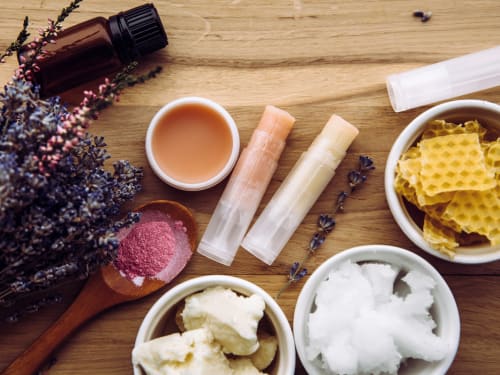
They can’t produce their own oils. They lose moisture significantly faster. And the thin layer of cells covering them means they’re more vulnerable to everything from Yorkshire winters to your morning coffee.
So, instead of recommending specific products (formulations vary wildly even with good ingredients), we’re examining what the research actually shows about treating dry lips—from petroleum jelly’s decades of safety data to emerging alternatives like tallow.
Beyond the Balm: Breaking the Cycle In this deep-dive explainer, we go under the surface to reveal the physiology of your lips. Why are they different to the rest of your skin, and what should we do (and not do) to keep them hydrated?
Video Transcript (Click to expand)
You know the drill. You put on lip balm in the morning, then again after your coffee, and again after lunch. And yet somehow, by the end of the day, your lips feel just as dry as when you started. It’s a super frustrating. Endless cycle.
But what if I told you the problem isn’t just your lip balm, but your whole approach to what your lips actually need? Right? If you feel like you’re basically addicted to your lip balm, constantly reapplying it but never getting any real lasting relief. You are definitely not alone.
The real question is, why do so many of these products that promise intense hydration just seem to fail us? Well, we’re going to breakdown the science of it.
Here’s the secret. The solution to finally healing your chapped lips isn’t hiding in some fancy new product. It’s all about understanding the unique and frankly, kind of disadvantage, biology of our lips. They’re built completely differently than the rest of the skin on your face.
To solve this whole thing, we’ve got to start with the “why?”. Why are our lips so ridiculously prone to getting dry and chapped in the first place? The answer is hiding in plain sight, in their fundamental structure. Which kind of puts them at a constant disadvantage.
OK, just look at this difference. It’s pretty wild. The protective outer layer of your lips is only three to five cells thick. Compare that to 15 to 20 on the rest of your face. That means moisture just escapes way, way more easily.
But the most important difference, the real game changer, is that very first line: oil glands.
That’s it, that’s the number. Zero. A big fat zero. That’s how many oil producing sebaceous glands are on the red part of your lips.
So while the skin on your face is busy making its own natural moisturiser all day long, your lips are just out there on their own and that right there, that’s the core issue.
Without those glands, your lips physically cannot create that natural oily barrier that keeps the rest of your skin hydrated and happy. They’re structurally defenceless against everything. The wind, the sun, the dry air in your office, even the coffee you’re drinking.
OK, so if our lips can’t make their own protection, what are we supposed to give them? What does a truly effective lip care formula look like when it’s based on biology and not just slick marketing? Luckily, there’s a real, scientifically backed framework for this.
The American Academy of Dermatology breaks down effective skin care into three really distinct categories of ingredients. Think of this as the ultimate toolkit for finally supporting your lips the right way. So here’s how it works.
First, you’ve got humectants like hyaluronic acid. They act like little magnets that pull moisture into the skin.
Second, emollients like Shea butter, they’re like the mortar between your skin cell bricks, they soften everything and fill in the cracks.
And third, you have occlusives like beeswax, they create a physical shield on top to lock all that good stuff in.
You really need all three. And this, this is why so many popular lip balms completely fail. A lot of them are almost entirely made of just one thing. An occlusive like petroleum jelly, now it’s brilliant at sealing things. But if your lips are already dry, all you’re doing is locking in the dryness.
A great formula gives you the moisture and softeners first and then seals it all in.
So let’s get practical with this new framework in mind. How does some of the most common ingredients out there actually stack up? We’re going to look at the real evidence, not just the marketing hype, for some of the most popular options, from the old classics to the new trends.
OK, let’s break these down.
Petroleum Jelly is the gold standard for sealing, but remember, it doesn’t add any moisture itself.
Lanolin is fantastic because it actually does both. It seals and it moisturises. The downside? It can feel sticky and some people are allergic to it.
Shea butter is a wonderful softener.
And then you have tallow. Theoretically, it’s a perfect match for our skin’s missing oils. But the hard clinical research on it is still pretty new. And just to be totally transparent, a 2024 scientific review says it all. The logic for using tallow makes a tonne of sense. It’s giving our lips the very oils they can’t make. But the hard clinical data just isn’t there yet. Not in the same way it is for something like petroleum jelly. It’s a really promising newcomer, but it’s not a proven champion. Yet.
Now let’s talk about that tingling sensation for a second. You know, from those plumping balms with stuff like menthol or cinnamon, it feels something happening, so it must be working, right?
But not so fast. That tingle is not a sign of hydration, it’s a sign of irritation.
These ingredients are literally causing mild inflammation, which makes your lips swell up temporarily. The American Academy of Dermatology actually warns this can damage your lips over time, creating a vicious cycle where your lips feel even dryer until that plumping effect wears off.
OK, so now we get the biology. We know the essential types of ingredients, and we know what to avoid. Let’s put it all together into a simple, effective action plan that you can start using today.
Here is your cheat sheet for reading ingredient labels. From now on you want to look for a product that combines softeners, the emollients, with sealers, the occlusives.
Getting a humectant in there is a fantastic bonus and for daytime this is absolutely non-negotiable: SPF 30. Your lips have zero melanin to protect themselves from sun damage. And here is what you should run away from. Heavy fragrances are just potential irritants. And like we just covered, if it stings, tingles, or burns, put it down. That product is creating a problem, not solving one. It’s just creating a cycle of dependency.
Finally, how you apply your lip balm is just as important as what’s in it. Pro tip, try putting it on slightly damp lips to seal in that extra bit of water. And applying a really thick layer at night is a total game changer because it has hours to work without being disturbed.
And please, for the love of your lips, try to break the habit of licking them. Your saliva just evaporates and leaves them even drier than before.
So the real takeaway here is this: having chronically chapped lips isn’t a sign that you’re failing at skin care, it’s a sign that you’ve been fighting against your body’s unique biology.
The goal is to shift your mindset from fighting dryness to instead supporting your lips’ natural state.
Think of it this way, your lips were sent into battle without a shield. They’re not weak, they’re just unequipped. By choosing products that give them the softeners, the sealers, and the sun protection they literally can’t make for themselves, you’re finally giving them the tools they’ve needed all along.
And that leaves us with one final thought. This whole principle of looking past the symptom to understand the underlying “why?”. It doesn’t just apply to our lips, right? It applies to so many areas of our health and our lives.
So what other frustrating problem could you solve if you stopped looking for a quick fix and started to really understand the real reason it’s happening in the first place?
Why lip skin is different (and why it matters)
Your face produces its own moisturiser. Your lips don’t.
That’s the fundamental difference that changes everything about lip care. Whilst your facial skin has thousands of sebaceous glands producing protective oils throughout the day, the vermilion (the red part of your lips) has exactly none.
Zero. Not a single oil-producing gland.
This means your lips are often dependent on external protection. They can’t create the lipid barrier that keeps your facial skin hydrated and protected.
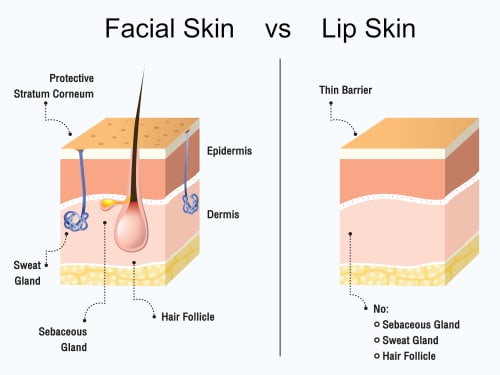
But it gets more challenging. The stratum corneum (your skin’s protective outer layer) is only 3-5 cell layers thick on your lips, compared to 15-20 layers on your face. [1] This thinner barrier allows moisture to escape more easily. Research shows lips experience significantly higher transepidermal water loss (TEWL) than facial skin. [2]
Add in lower ceramide content (ceramides are the lipids that hold skin cells together like mortar between bricks), and you’ve got tissue that’s structurally vulnerable to dehydration.
Then there’s the constant exposure. Your lips face everything your face does - weather, UV radiation, pollution - but without melanin to protect them from sun damage. Plus, the unique challenges of eating, drinking, talking, and the unconscious habit of licking (which actually makes dryness worse, since saliva evaporates and leaves lips drier than before).
So how do lips maintain any baseline moisture at all? The inner labial mucosa (the wet part inside your mouth) contains numerous minor salivary glands that continuously secrete moisture. [3] The outer vermilion also has an extensive blood supply, bringing nutrients and hydration from within. This rich capillary network is why lips appear red or pink.
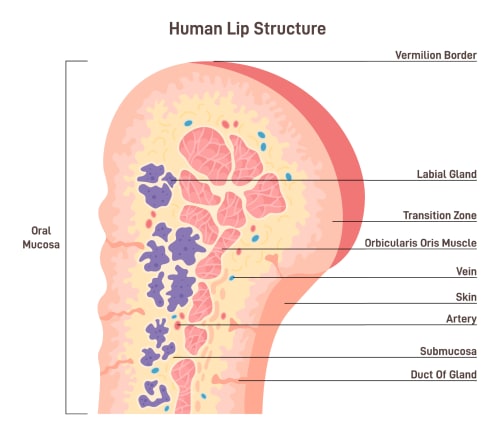
But this baseline moisture isn’t quite enough for the exposed vermilion. The blood supply and saliva migration from the inner surface provide some hydration, but they can’t always fully compensate for the lack of protective oils, especially when considering the constant environmental exposure.
This is why your lips feel dry even when your face doesn’t. Why do your lips chap in winter whilst your cheeks stay comfortable? Why does the lip balm you apply after breakfast completely disappear by lunch?
Your lips aren’t failing at being skin. They’re just working with far fewer resources.
What lip skin actually needs
The American Academy of Dermatology identifies three categories of ingredients that support lip hydration. [4] Understanding these helps you look beyond marketing claims and choose products based on what your lips genuinely need.
Humectants draw moisture from the environment and from deeper skin layers. Think glycerin, hyaluronic acid, and aloe vera. They attract water like a magnet.
Emollients soften skin and fill the microscopic gaps between cells. These are your oils and butters: shea butter, plant oils, and yes, tallow. They create smoothness and flexibility.
Occlusives seal everything in by forming a protective layer on the surface. Beeswax, petroleum jelly, and plant waxes act like a barrier, preventing moisture from evaporating.
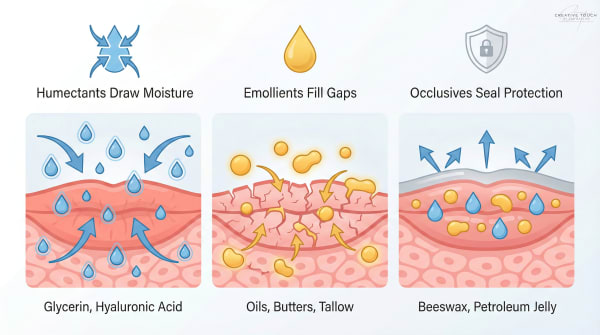
Here’s what most people don’t realise: lips need all three working together.
Most conventional lip balms focus heavily on occlusives alone. Petroleum jelly, for instance, is brilliant at sealing in moisture, reducing TEWL by up to 99%. But if your lips are already dehydrated, you’re just sealing in dryness.
And here’s where the sebaceous gland issue becomes critical: since your lips can’t produce emollients naturally, external sources become all the more important. Your face produces its own oils to fill those cellular gaps. Your lips may need you to provide them.
Quality matters more than quantity of application. A well-formulated balm applied twice daily can outperform cheap petroleum jelly reapplied ten times.
So which emollients actually match what lips need? Let’s examine the evidence.
The evidence on lip care ingredients
Not all lip care ingredients have equal scientific backing. Some have decades of safety data and proven effectiveness. Others sound promising based on their composition but lack direct clinical trials. A few are heavily marketed despite weak evidence.
Here’s how they actually rank.
The well-researched classics
Petroleum jelly (petrolatum)
This is the gold standard by sheer volume of research. Petroleum jelly has FDA approval for treating chapped lips, with decades of safety data supporting its use.
The mechanism is simple: it’s a pure occlusive. Applied to lips, it reduces moisture loss by up to 99%, creating an effective barrier against environmental damage. [5]
But here’s the limitation: it provides no nutrients or emollient action. Petroleum jelly seals in whatever moisture is already present. If your lips are dehydrated when you apply it, you’re just locking in dryness.
There’s also a growing concern about mineral oil saturated hydrocarbons (MOSH) contamination. A Swiss study published in PubMed found that 68% of lip care products tested exceeded recommended MOSH limits. [6] Researchers noted that since lip products are largely ingested through eating and drinking, these levels should be reduced.
Petroleum jelly works brilliantly for short-term barrier repair during healing. But it doesn’t address the nutrient gap your lips face from lacking natural oil production.
Extensively used in medical settings for nipple care during breastfeeding and wound healing, lanolin has solid real-world evidence behind it.
It functions as both humectant and occlusive—it can actually absorb moisture from the air whilst also sealing it in. Lanolin contains some lipids chemically similar to those found in skin, giving it emollient properties beyond pure petroleum products.
The trade-off is texture. Lanolin feels thicker and stickier than lighter oils, which some people find unpleasant. It’s also a potential allergen for a small percentage of people, particularly those sensitive to wool.
Shea butter
Widely studied for skin barrier repair, shea butter provides both emollient and mild occlusive benefits. It contains vitamins A, and E, along with fatty acids that soften and protect skin.
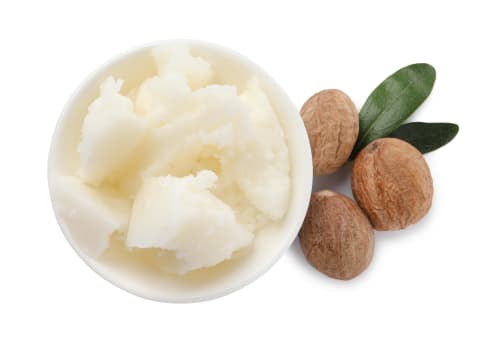
The evidence base focuses mainly on general skin care rather than lips specifically, but the mechanism of action translates well. Shea butter fills gaps between cells whilst providing some moisture-sealing action.
Some people find it feels heavy or takes time to absorb. But for lips that need serious barrier support, particularly during winter, shea butter’s dual action makes it effective.
Ingredients with developing evidence
Hyaluronic acid (topical)
Hyaluronic acid is well-studied for facial skin care, with less direct research on lip application. But there’s promising logic to its use.
The challenge is molecular weight. Most products don’t specify whether they use low or high-molecular-weight HA, and this matters significantly. Research shows low molecular weight HA (20-300 kDa) achieves 14-19% skin penetration, whilst high molecular weight (1,000-1,400 kDa) only manages 2.7-10%. [7]
For lips, the thinner stratum corneum might actually improve penetration rates compared to facial skin. That’s theoretical rather than proven, but it’s a reasonable hypothesis based on tissue structure.
The honest assessment: hyaluronic acid is a promising humectant for lip care, but its effectiveness depends entirely on formulation details that most brands don’t disclose.
Plant oils (coconut, jojoba, almond)
The fatty acid profiles of various plant oils are well-documented. What’s less clear is how effectively they perform specifically for lip hydration in controlled trials.
These oils provide emollient action, and many contain vitamins. Jojoba oil has the composition closest to human sebum among plant options, which makes theoretical sense for replacing what lips can’t produce themselves.
But there’s individual variation. Some people find certain plant oils actually drying, which seems paradoxical but relates to how quickly the oils are absorbed versus evaporated.
Plant oils can be excellent choices, particularly when combined with occlusives. Just be prepared for some trial and error to find which works for your particular lip biology.
Beeswax
Traditional use across cultures, plus some modern research on skin benefits, gives beeswax reasonable credibility.
It functions primarily as an occlusive with mild emollient properties. Beeswax creates a protective barrier whilst allowing some moisture exchange, unlike petroleum jelly’s complete seal.
The natural, non-toxic-if-ingested profile makes it appealing for lip products. The potential downside is texture—some formulations feel waxy rather than smooth.
The newcomers with potential
Grass-fed beef tallow
Here’s where we need to be particularly honest about evidence versus theory.
A 2024 scoping review published in the journal Cureus examined tallow in skincare. [8] After screening 147 studies, only 19 met the inclusion criteria for analysis. The authors explicitly stated: “There are significant research gaps in the uses of tallow on human skin.”
No randomised controlled trials exist examining tallow specifically for lip care. That’s the evidence reality.
But the compositional logic is genuinely compelling. Tallow contains 37-47% oleic acid, 26-28% palmitic acid, and 17-25% stearic acid. These fatty acids mirror components found in human sebum, the very thing your lips can’t produce themselves.
It also contains fat-soluble vitamins A, D, E, and K, though absorption rates into lip tissue remain uncertain.
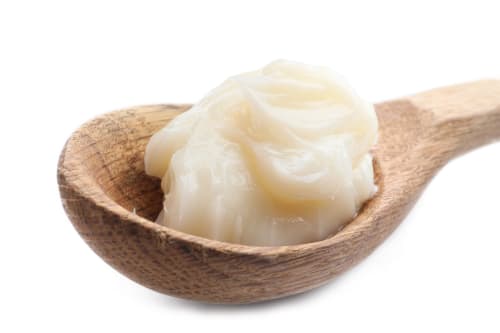
Here’s what makes tallow distinct: it functions as both an emollient and an occlusive. It fills the microscopic gaps between skin cells (addressing the missing sebum issue) whilst also creating a protective barrier against moisture loss.
Individual fatty acids present in tallow - stearic acid, palmitic acid - have Cosmetic Ingredient Review (CIR) safety approval. Limited studies on tallow emulsions show measurable skin hydration effects.
What’s not established: whether tallow is superior to other emollients for lips, its long-term safety profile compared to petroleum jelly’s decades of testing, or whether the vitamins actually absorb into lip tissue in meaningful amounts.
One notable advantage: tallow contains no petroleum derivatives, meaning zero risk of MOSH / POSH contamination. For those concerned about the Swiss study findings, this matters.
A 2025 analysis in the Journal of Cosmetic Dermatology found that most tallow skincare claims on social media lacked cited evidence, with the majority of promoters showing financial bias. [9] We’re being transparent here: the compositional logic is strong, but controlled studies are sparse.
That doesn’t mean tallow doesn’t work. It means we’re still building the evidence base that petroleum jelly has established over decades.
The theoretical fit is sound: providing lipids that mirror what lips should produce but can’t. Whether that translates to superior real-world performance remains to be proven through rigorous research.
The anti-ageing category: peptides
Peptide lip products
The beauty industry’s latest trend positions peptides as the sophisticated solution for lip ageing, moving beyond basic moisture to target collagen production, fine lines, and volume loss. Products now range from £5 drugstore options to £30 dermatologist-created treatments, with brands explicitly marketing “anti-ageing for lips.”
But here’s what the research actually shows: peptides have legitimate collagen-stimulating effects in laboratory studies and moderate evidence for facial skin. Direct clinical evidence for lip tissue specifically? Virtually non-existent.
This is a significant gap. Lips aren’t just smaller sections of facial skin. Remember the structural differences we covered earlier - thinner barrier, no sebaceous glands, constant saliva exposure, different moisture dynamics. A peptide that performs well on facial skin might behave entirely differently on lip tissue.
The science (and the gaps)
Several peptide types appear in lip products, each with distinct mechanisms:
Signal peptides like Palmitoyl Tripeptide-1 ( Matrixyl) theoretically instruct fibroblasts to produce more collagen. Laboratory studies show genuine collagen synthesis increases, up to 117% in some in vitro experiments. [11] A double-blind study on periocular skin found 18% decrease in wrinkle depth after 28 days. [12]
That’s facial skin. For lips? No equivalent studies exist.
Carrier peptides like copper peptide (GHK-Cu) deliver copper ions needed for wound healing and collagen formation. Research demonstrates increased collagen in 70% of volunteers, [13] outperforming both vitamin C and retinoic acid in some comparisons. Again, these studies focused on facial or body skin.
Neurotransmitter-inhibiting peptides like Acetyl Hexapeptide-8 (Argireline) claim to reduce expression lines by temporarily inhibiting muscle contractions. The theory mimics Botox’s mechanism topically. The reality? A 2014 study found that only 0.22% of the applied dose had penetrated the stratum corneum after 24 hours. [14]
The most commonly cited lip-specific study examined a two-step treatment containing palmitoyl-GHK tripeptide complex alongside hyaluronic acid and growth factors. [15] Results showed 81-94% reduction in fine lip lines, but this open-label, manufacturer-sponsored trial used multiple active ingredients simultaneously. Isolating the peptide effect from the hyaluronic acid or other components? Impossible.
The penetration paradox
Here’s the fundamental challenge: most peptides are too large to penetrate skin effectively.
The “500 Dalton rule” states molecules generally need to be under 500 Daltons to pass through the stratum corneum. [16] Acetyl Hexapeptide-8 is 889 Daltons. It’s simply too big, and the molecule’s hydrophilic (water-loving) nature makes crossing the lipid-rich skin barrier even harder.
Formulation chemists address this through palmitoylation - adding fatty acid chains that increase fat-solubility. Palmitoyl Tripeptide-1 has better penetration potential than unmodified tripeptides. Some brands use liposome encapsulation or penetration enhancers.
But lip tissue presents unique challenges. The thinner stratum corneum (3-5 layers versus 15-20 on facial skin) could theoretically improve penetration. However, lips lack hair follicles and sebaceous glands entirely, eliminating the natural lipid pathways that help substances absorb through normal skin. [17] Everything must penetrate through intercellular routes alone.
The saliva problem
No published studies examine how salivary enzymes affect peptide stability. This is a critical gap.
Saliva contains proteolytic enzymes designed to digest food, including the proteins that peptides are built from. You’re applying a protein-based active ingredient to tissue that’s constantly exposed to protein-digesting enzymes. Eating, drinking, talking, and unconscious lip-licking all reduce residence time.
The mean oral cavity pH over the course of 48 hours is approximately 7.27. [18] Peptides show pH sensitivity, with optimal stability typically at pH 4-6. We simply don’t know how quickly peptides degrade in the lip environment compared to protected facial skin.
How peptides differ from what you’re already using
This matters for understanding what you’re actually buying.
Traditional lip balm ingredients work at the surface. Occlusives create physical barriers. Humectants attract water. Emollients fill gaps between cells. Results are immediate and tangible.
Peptides function as cellular messengers working at the dermal level. They “tell” fibroblasts to produce collagen. This takes time - 4 to 12 weeks of consistent use before subtle effects emerge. And they require successful penetration to reach target cells in the first place.
Most immediate “plumping” you notice from peptide lip products? That comes from the hyaluronic acid, glycerin, and emollient base, not the peptides themselves.
A 2022 clinical study found hyaluronic acid serum combined with peptide cream produced 79% improvement in facial skin texture over 12 weeks. [19] The synergy is real, but distinguishing which ingredient drives which benefit remains unclear. The peptides might be supporting long-term collagen production whilst the HA provides immediate hydration.
The price premium reality
Peptide lip products command 3-6x the price of drugstore alternatives. Revolution Beauty’s peptide balm costs £5. Rhode’s version is £18. Dr. Whitney Bowe’s Tri-Liptide treatment reaches £28.
What are you paying for?
Transparency varies dramatically. The Inkey List explicitly states 6% tripeptide complex. Most brands simply list “peptides” without specifying type, concentration, or molecular weight. Paula’s Choice names all three peptides used (Tridecapeptide-1, Palmitoyl Tripeptide-1, Palmitoyl Tripeptide-38) but doesn’t disclose concentrations. Rhode describes theirs only as “short-chain amino acids.”
This opacity matters. A 1% peptide concentration might be effective. A 0.01% concentration is likely decorative - present on the label but at levels too low for biological activity.
Dermatologist Dr. Heather Rogers offers perspective: “Peptides are helpful, not heroic. They can support skin health by promoting collagen—but they’re not the cornerstone of your routine. Ingredients like retinoids, AHAs, or vitamin C often have stronger evidence for anti-ageing.” [20]
The honest assessment? You’re primarily paying for high-quality hyaluronic acid, ceramides, and emollient bases that deliver proven immediate hydration. The peptide component offers theoretical additional anti-ageing potential, but expecting results comparable to injectable treatments sets unrealistic expectations.
If you’re curious about peptides
For those specifically concerned about lip lines and age-related volume loss, peptide products may offer modest benefit if expectations are managed:
Look for palmitoylated peptides. Names starting with “palmitoyl” (Palmitoyl Tripeptide-1, Palmitoyl Pentapeptide-4) indicate fatty acid modification that improves penetration. Unmodified peptides face significant delivery challenges.
Seek concentration disclosure. The Inkey List’s 6% provides a benchmark. Products that won’t specify concentration should raise questions about whether peptides are present at therapeutic levels or marketing levels.
Prioritise combination formulas. Peptides work synergistically with hyaluronic acid and ceramides. A product containing all three addresses both immediate hydration and potential long-term collagen support.
Commit to 8-12 weeks minimum. Cellular signalling takes time. If you’re expecting overnight transformation, save your money. The hydrating base ingredients will work immediately, but peptide effects, if they occur on lips, require consistent use over months.
UK options worth considering:
- The Inkey List Tripeptide Plumping Lip Balm (£11) - transparent about 6% concentration
- Revolution Beauty Juicy Peptide Lip Balm (£5) - performed well in comparative testing
- MUA Hydra Juice Peptide Lip Balm (approximately £2.50) - contains Palmitoyl Tripeptide-1
Application strategy for maximum benefit:
Apply peptide products to slightly damp lips (improves absorption). Use them before heavy occlusives (allows peptide penetration before sealing). Apply at bedtime when eating and drinking won’t constantly remove the product. Consider layering an affordable occlusive like CeraVe Healing Ointment over your peptide product to extend residence time overnight.
The reality check
Peptide lip products represent incremental innovation rather than revolutionary breakthrough.
The core science of peptide-mediated collagen stimulation is legitimate on facial skin. The translation to lip tissue specifically remains inadequately studied. Fundamental questions about penetration through the unique lip barrier, stability in constant saliva exposure, and actual collagen effects in vermilion tissue remain unanswered.
The premium pricing primarily buys you excellent hydrating base ingredients. The peptide component might provide additional anti-ageing benefit, but only with realistic expectations, consistent long-term use, and understanding that results won’t approach what injectable treatments deliver.
Most cost-effective approach? Combine affordable occlusive protection (CeraVe, Aquaphor) for general daily use with a mid-range peptide product (The Inkey List, Revolution) used consistently overnight. This captures both immediate barrier support and whatever gradual peptide benefit proves real, without paying luxury prices for unproven claims.
The natural lip plumping question
People searching for “bigger lips without filler” often land on articles about lip care. Let’s address this honestly.
Hydration does create some volume but we’re talking subtle, temporary plumping from well-moisturised cells, not the dramatic enhancement people picture when searching “bigger lips without filler.”
Just as a well-hydrated plant looks plump, vibrant, and with leaves that catch the light, a dehydrated plant looks shrunken and dull. The hydration creates real physical volume at a cellular level, but it’s the plant’s natural size, not structural enlargement.
Well-hydrated lips reflect light better, have richer colour, and look fuller than when chronically dehydrated. Optimal moisture retention can make a noticeable difference to how your lips appear. But this effect lasts hours, not months, and it’s about reaching your lips’ natural healthy state rather than adding volume beyond their structure.
Substantial, lasting volume requires hyaluronic acid injections. Our Lumi Pro Lips treatment uses non-cross-linked HA that works differently from traditional lip fillers. Rather than adding volume through gel material, it attracts and binds water molecules within lip tissue itself, creating natural-looking fullness through deep hydration that lasts months. Traditional hyaluronic acid lip fillers use cross-linked gel to create immediate structural volume, whilst Lumi Pro works with your body’s natural moisture-binding capacity for subtle, gradual enhancement.
What about those “plumping” lip products that tingle?
They contain irritants such as menthol, cinnamon oil, and capsaicin. These create inflammation, which causes temporary swelling. The American Academy of Dermatology warns that repeated irritation damages lip tissue over time. [10] This isn’t plumping. It’s controlled damage.
Peptide-based lip products show more promise than irritant-based plumpers, but the evidence remains mixed. We’ve now covered peptides in detail in the ingredients section above—the science for collagen stimulation on facial skin is moderate to strong, whilst lip-specific research is virtually non-existent. Results require 8-12 weeks of consistent use, and effects are subtle rather than dramatic. They’re not transformative, but they might support gradual collagen production if formulated properly. Far better than damaging your lips with cinnamon oil, but nowhere near what injectable treatments achieve.
Here’s the wellness perspective: optimal hydration is about restoring your lips to their fullest natural version, not enlarging them beyond their structure. Chronic dehydration makes lips appear smaller and flatter than their actual size. Proper care shows you what your lips look like when they’re functioning well.
If you’re genuinely seeking lasting volume, Lumi Pro Lips provides measured enhancement through your body’s natural moisture-binding capacity. For daily maintenance, focus on hydration that supports rather than irritates.
How to choose lip care that actually works
The most effective lip care combines ingredients rather than relying on a single hero component.
Look for formulas that include:
- An emollient that mimics skin lipids - tallow, jojoba oil, shea butter
- An occlusive to seal everything in - beeswax, plant waxes, or petroleum jelly if MOSH concerns don’t worry you
- Optional humectant - glycerin, hyaluronic acid, or aloe vera
- Optional peptides for anti-ageing concerns - palmitoylated peptides (Matrixyl, palmitoyl tripeptides) if you’re specifically targeting lip lines and volume loss, understanding this is a long-term investment requiring 8-12 weeks of consistent use
- Optional vitamin E - for antioxidant protection against environmental damage
What to avoid:
Heavy fragrances act as potential irritants for the thin, sensitive tissue of the lips. Menthol, cinnamon, and capsaicin create that tingling sensation through irritation. If a product feels “addictive” (you need to reapply constantly, and your lips feel worse without it), it likely contains mild irritants creating a dependency cycle.
Anything that stings or burns is damaging tissue, not helping it.
Application matters as much as formula
Apply lip balm to damp lips when possible. Splashing your face with water, then immediately sealing that moisture in, works better than applying to completely dry lips.
Night-time application is crucial. You’re not talking, eating, or drinking for hours, giving ingredients time to work without being constantly disrupted.
Reapply after meals and drinks. Physical removal happens—you’ve literally eaten your lip balm. That’s normal, not product failure.
Don’t lick your lips. Here’s why this matters more than you might think: saliva contains digestive enzymes (amylase, lipase) designed to break down food. When you lick your lips, you’re applying those same enzymes to delicate tissue that’s already vulnerable due to its thin structure. The enzymes break down the proteins and lipids in your lip tissue, whilst the moisture evaporates quickly—leaving your lips both damaged and drier than before. It’s a hard habit to break, but understanding that you’re literally digesting your own lips makes it easier to resist.
Use SPF during the day, but choose your filters carefully. Lips have no melanin protection and are vulnerable to UV damage, but many chemical sunscreen filters (avobenzone, oxybenzone, octinoxate) can actually irritate the thin vermilion border, potentially worsening the dryness you’re trying to treat.
Look for mineral (physical) SPF instead: Zinc oxide and titanium dioxide sit on the surface rather than absorbing into tissue. Zinc oxide is particularly beneficial—it’s the same ingredient used in nappy rash cream because it’s both a UV blocker and a skin protectant. Many lip balms now include broad-spectrum mineral SPF 30.
This matters more for lips than facial skin because you’re applying the product to tissue that’s already structurally vulnerable, lacks a robust barrier, and will be partly ingested throughout the day. Mineral filters are generally better tolerated for this delicate application.
For peptide products specifically: The expensive peptides work best when applied to slightly damp lips (improving absorption), before any heavy occlusives (which would block penetration), and ideally at bedtime when hours without eating or drinking maximises contact time. If you’re investing in peptide lip products, optimise application timing to give them the best chance of actually reaching target cells. Layer an affordable occlusive over your peptide product at night to extend residence time whilst you sleep.
Dealing with flaky, chapped texture
If your lips are severely chapped with visible flaking, you’re facing a dilemma. Applying expensive oils and balms on top of a layer of dead, hardened skin cells means the product just sits on the surface rather than reaching the living tissue underneath.
But here’s the challenge: the vermilion is only 3-5 cell layers thick. Aggressive scrubbing can damage this already-vulnerable barrier.
The gentle approach:
First, soften the dead tissue. Apply a thick layer of an emollient (plain oil, petroleum jelly, or your chosen balm) and leave it for 5-10 minutes. This softens the hardened cells without tearing.
Then gently wipe away loosened flakes with a soft, damp cloth. Don’t pick or pull—let only the tissue that’s ready to release come away naturally.
Chemical exfoliation for chronic chapping:
If you deal with constant texture buildup, look for lip treatments containing gentle exfoliating ingredients:
- Urea (5-10%) - Softens hardened skin cells whilst hydrating
- Lactic acid (low percentage) - Gently dissolves the bonds between dead cells
- Lanolin - Has natural softening properties for thick, crusty texture
These work by dissolving the “glue” between dead cells rather than physically scrubbing, which is safer for thin lip tissue.
What to avoid:
Sugar scrubs and salt scrubs can tear the delicate vermilion, especially if you scrub vigorously. If you use them, be extraordinarily gentle. Let the granules dissolve slightly first, then barely brush across the surface.
Most importantly: if you’re constantly dealing with thick, crusty buildup that won’t resolve with gentle care, see your GP. Persistent hyperkeratosis (thickened skin) on lips can indicate underlying vitamin deficiencies or skin conditions that need medical attention.
Seasonal adjustments
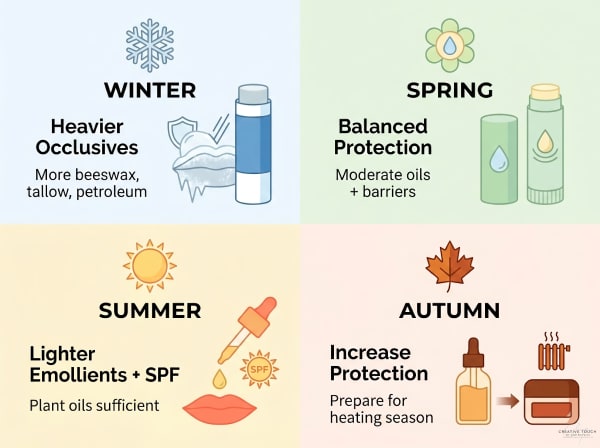
Winter requires heavier occlusives. The combination of cold air outside and dry heating indoors increases TEWL significantly. Formulas with more beeswax or tallow work better than light plant oils alone.
Summer allows lighter emollients. Plant oils often suffice when humidity is higher, and heating systems aren’t running.
Indoor heating increases moisture loss year-round. If you work in an office with forced-air heating, you’ll need more frequent application than someone working outdoors.
When lip care isn’t enough
Persistent cracking at the corners of your mouth ( angular cheilitis) can indicate fungal or bacterial infection. This requires medical assessment, not just a better moisturiser.
Bleeding or deep splits that don’t heal suggest you need professional evaluation rather than just lip balm.
Sudden sensitivity to products you previously tolerated might signal contact dermatitis from a new ingredient. Chronic dryness despite excellent care could indicate a vitamin deficiency, dehydration, or medication side effects.
If lips don’t improve with a good care routine after two weeks, or if you experience pain or bleeding, consult your GP.
Your lips can tell you about your overall health. Persistent issues might signal that your body needs support beyond topical care—better hydration, improved nutrition, or medical attention.
The tallow alternative (if you’re curious)
We stock grass-fed tallow lip balm as part of our natural skincare range. Here’s why it makes theoretical sense specifically for lips.
Tallow addresses the fundamental gap: lips need lipids they can’t produce themselves. The fatty acid profile in grass-fed tallow resembles components of human sebum—oleic acid, palmitic acid, and stearic acid in proportions similar to what your facial skin produces naturally.
It provides dual action as both an emollient and occlusive, filling cellular gaps whilst sealing moisture in. The nutrient profile includes fat-soluble vitamins A, D, E, and K. And there’s no petroleum derivative, meaning zero MOSH contamination risk.
The honest limitations: we don’t have the decades of clinical research that petroleum jelly has. The texture may not suit everyone’s preference. If you follow a vegan or vegetarian lifestyle, animal-derived ingredients won’t align with your values.
Is tallow better than other options? The research isn’t available yet to make that claim.
But for those seeking natural alternatives to petroleum-based products, it’s a theoretically sound choice rooted in your body’s actual biology. Your lips need the lipids they’re missing. Tallow provides fatty acids similar to sebum, alongside vitamins that support skin health.
We’re not claiming it’s magical. We’re saying the compositional logic aligns with what we know about lip physiology.
What’s our experience? It works well, the texture takes a little adjustment, but it lasts longer between applications than petroleum-based alternatives. That’s not clinical evidence, but it is what we’ve found from using ourselves. That’s generally how products end up in our range - we try them first, like them, and feel confident offering them to our clients.
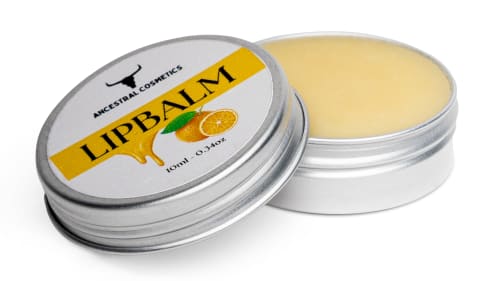
Explore our tallow skincare range, including lip balm formulated specifically for tissue that can’t produce its own protective oils.
Understanding your lips changes everything
Your lips are structurally different from your facial skin. No oil production. Thinner barrier. Higher moisture loss. Constant exposure without the protective mechanisms your face enjoys.
This isn’t a flaw. It’s biology.
Understanding why your lips behave differently helps you choose care that actually addresses their needs. It’s not about finding the “perfect” product—those don’t exist. It’s about understanding the physiology and selecting ingredients that work with it.
Whether you choose petroleum jelly, plant oils, lanolin, or tallow, the principle remains: your lips need external sources of the protective lipids they can’t create themselves. Combined with occlusives to seal that protection in, and humectants to draw moisture, you’re supporting rather than fighting your body’s natural structure.
The chronic reapplication cycle you’re experiencing? That’s often a mismatch between product formulation and what lip tissue actually requires. Most products focus on occlusion alone, sealing in moisture that’s already escaped.
Proper lip care provides what’s missing first, then seals it in.
Want hydration that works from within rather than relying on topical application? Discover how Lumi Pro Lips provides lasting lip enhancement through your body’s natural moisture-binding capacity—hyaluronic acid delivered directly where it works, creating genuine volume that lasts months.
For daily maintenance, choose products that acknowledge your lips’ unique biology. Emollients to replace missing sebum. Occlusives to protect. Humectants to draw moisture. All working together to support tissue that’s managing without the resources your facial skin takes for granted.
Your lips aren’t failing. They’re just working with fewer tools. Give them what they need.
References
StatPearls (2023). Anatomy, Head and Neck, Lips. StatPearls. ncbi.nlm.nih.gov/books/NBK507900/ (Accessed: 2025-12-09)
Dobos, K (2023). The Anatomy of Healthy Lips. Allured Business Media. skininc.com/…tomy-of-healthy-lips
Jahan-Parwar, B (2025). Lips and Perioral Region Anatomy. Medscape. emedicine.medscape.com/article/835209-overview (Accessed: 2025-12-09)
AAD (2025). 7 dermatologists’ tips for healing dry, chapped lips. American Academy of Dermatology Association. aad.org/…eal-dry-chapped-lips (Accessed: 2025-12-09)
Saunders, N (2025). The 10 Best Lip Balms For Dry Lips Of 2025. Women’s Health. womenshealthmag.com/…8819/best-lip-balms/ (Accessed: 2025-12-09)
Niederer, M., Stebler, T., Grob, K. (2015). Mineral oil and synthetic hydrocarbons in cosmetic lip products. International Journal of Cosmetic Science, 38(2), 194-200. doi.org/10.1111/ics.12276
doi: 10.1111/ics.12276Essendoubi, M., Gobinet, C., Reynaud, R., Angiboust, J., Manfait, M., Piot, O. (2015). Human skin penetration of hyaluronic acid of different molecular weights as probed by Raman spectroscopy. Skin Research and Technology, 22(1), 55-62. doi.org/10.1111/srt.12228
doi: 10.1111/srt.12228Russell, M., Sandhu, M., Vail, M., Haran, C., Batool, U., Leo, J. (2024). Tallow, Rendered Animal Fat, and Its Biocompatibility With Skin: A Scoping Review. Cureus. doi.org/10.7759/cureus.60981
doi: 10.7759/cureus.60981Almatroud, L., Choi, S., Libson, K., Ashack, K. (2025). Beef Tallow‐Based Skincare Claims in Social Media: A Cross‐Sectional Analysis. Journal of Cosmetic Dermatology, 24(12). doi.org/10.1111/jocd.70544
doi: 10.1111/jocd.70544Firoz, E., Levin, J., Hartman, R., James, W. (2009). Lip plumper contact urticaria. Journal of the American Academy of Dermatology, 60(5), 861-863. doi.org/10.1016/j.jaad.2008.09.028
doi: 10.1016/j.jaad.2008.09.028Gorouhi, F., Maibach, H. (2009). Role of topical peptides in preventing or treating aged skin. International Journal of Cosmetic Science, 31(5), 327-345. doi.org/10.1111/j.1468-2494.2009.00490.x
doi: 10.1111/j.1468-2494.2009.00490.xRobinson, L., Fitzgerald, N., Doughty, D., Dawes, N., Berge, C., Bissett, D. (2005). Topical palmitoyl pentapeptide provides improvement in photoaged human facial skin1. International Journal of Cosmetic Science, 27(3), 155-160. doi.org/10.1111/j.1467-2494.2005.00261.x
doi: 10.1111/j.1467-2494.2005.00261.xPickart, L., Vasquez-Soltero, J., Margolina, A. (2014). GHK and DNA: Resetting the Human Genome to Health. BioMed Research International, 2014(), 1-10. doi.org/10.1155/2014/151479
doi: 10.1155/2014/151479Kraeling, M., Zhou, W., Wang, P., Ogunsola, O. (2014). In vitroskin penetration of acetyl hexapeptide-8 from a cosmetic formulation. Cutaneous and Ocular Toxicology, 34(1), 46-52. doi.org/10.3109/15569527.2014.894521
doi: 10.3109/15569527.2014.894521Trookman, N.S., Rizer, R.L., Ford, R., Mehta, R., Gotz, V. (2009). Clinical assessment of a combination lip treatment to restore moisturization and fullness. The Journal of clinical and aesthetic dermatology, 2(12), 44-8. PubMed: 20725584
pmid20725584Mortazavi, S., Moghimi, H. (2022). Skin permeability, a dismissed necessity for anti‐wrinkle peptide performance. International Journal of Cosmetic Science, 44(2), 232-248. doi.org/10.1111/ics.12770
doi: 10.1111/ics.12770Shang, J., Feng, X., Chen, Y., Gu, Z., Liu, Y. (2024). Human lip vermilion: Physiology and age‐related changes. Journal of Cosmetic Dermatology, 23(8), 2676-2680. doi.org/10.1111/jocd.16317
doi: 10.1111/jocd.16317Choi, J., Lyons, K., Kieser, J., Waddell, N. (2017). Diurnal variation of intraoral pH and temperature. BDJ Open, 3(1), . doi.org/10.1038/bdjopen.2017.15
doi: 10.1038/bdjopen.2017.15Gold, M., Biron, J., Wilson, A., Nelson, D. (2022). Efficacy and tolerability of a hyaluronic acid‐based serum and a peptide‐rich cream for the face and neck in subjects with photodamaged skin. Journal of Cosmetic Dermatology, 21(8), 3458-3463. doi.org/10.1111/jocd.14981
doi: 10.1111/jocd.14981Heather D. Rogers, MD (2025). Dermatologist Explains Peptides in Skincare: Worth it or Worth Skipping?. Doctor Rogers Skin Care. doctorrogers.com/…it-or-worth-skipping